
- May 15, 2026
- Posted by: Dave Kurlan
- Categories: Analogies, Best Top 10 Lists, Bob Chronicles, Sales Pipeline and Forecast, Understanding the Sales Force

Bob is at it again! When I coached him last week, his pipeline had two big problems: not enough opportunities, and way too many whales. You know the type—those deals with so many zeros they make your eyes water. If you’ve read my other articles on Bob, you know he’s in the bottom half of all salespeople. And when it comes to landing a whale? He’s about as effective as a bait shop fisherman trying to catch minnows with a net full of holes.
Poor Bob—chasing those big fish while his pipeline starves. It’s exhausting, demoralizing, and all too common.
There are so many reasons to not have too many whales in the pipeline. Here are ten that quickly come to mind:
- Skewed pipeline value – Large opportunities make the pipeline seem stronger than it is.
- Longer sales cycles – Long sales cycles and passive qualifying mean that it could take 9-24 months to win or lose.
- Lower margins – As a general rule, margins tend to be smaller with large deals and accounts.
- Inaccurate forecasts – The likelihood of pipeline forecasts being inaccurate increase with whales in the pipeline.
- Rebuild the pipeline – depending on the length of your sales cycle, it can take months to successfully refill the pipeline after the win or loss of a whale.
- Tunnel vision – Salespeople often focus on whales to the exclusion of other opportunities.
- Hopium – Salespeople tend to employ a greater amount of hope with whales, and hope is not a strategy
- Quota – By focusing on whales, salespeople are more likely to miss quota in at least 3 and possibly all 4 quarters.
- Termination – Salespeople who focus on whales are often terminated for lack of performance.
- Passive Qualifying – Salespeople don’t want to lose out on their whales, so they don’t qualify/disqualify as thoroughly as they should.
I believe most salespeople feel there is a certain allure and notoriety to adding a whale to the pipeline. But those extra zeros from the size of the potential opportunity cause problems for a huge percentage of salespeople.
Money Tolerance is the point at which salespeople say to themselves, “That’s a lot of money.” It’s their choking point. That moment when their stomach drops and they think, ‘This is way more than I’d ever spend’… and suddenly every objection feels like truth. And when the budget, ask, cost, or fee exceeds their choking point, they become vulnerable to anything and everything from a litany of objections and bluffs, including, but not limited to:
- That’s more than we thought
- That’s more than we have budgeted
- It’s more than the other quotes/proposals we received
- It’s more than we’re willing to spend
A pretty sizable percentage of salespeople have this issue! Check out the table below which shows the percentage of salespeople in four cohorts that have Low Money Tolerance.
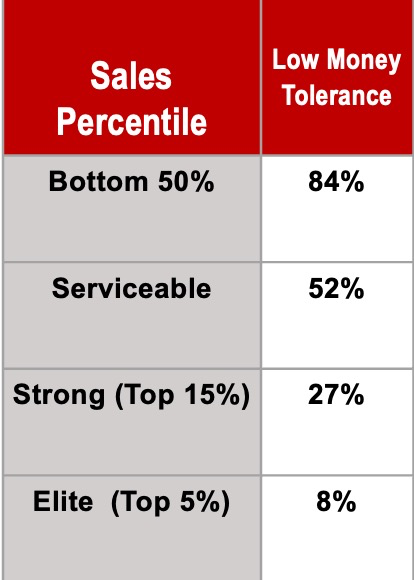
While few of the top salespeople have this weakness, most of the bottom 50% have it. Bob is one of those salespeople. Depending on the other hidden weaknesses a salesperson might have, they might try to offer a better price (bad strategy), become resigned to losing the opportunity (worse strategy), or push forward (stupid strategy) despite the obstacle.
Low Money Tolerance is one of the attributes of the Sales Core Competency, Supportive Buy Cycle. Buy Cycle is just 1 of the 21 Sales Core Competencies and belongs to the group of 6 Competencies known as Sales DNA. Sales DNA is a collection of competencies which, when strong, support the execution of Sales Process, Sales Methodology, Sales Strategy and Sales Tactics. However, when Sales DNA is weak, rather than supporting those 4 things, it tends to sabotage them instead.
Back to Buy Cycle. In addition to Money Tolerance, it also includes the other elements of how a salesperson makes a major purchasing decision, including, Research, Comparison Shopping, Price Shopping, and Thinking Over the Decision.
Most of the salespeople who have a strong and supportive Buy Cycle competency can be found in the top 5% of all salespeople. Not surprisingly, salespeople with the most non-supportive Buy Cycles are found in the bottom 50% of all salespeople.
Carefully review the table below, which has 2 attributes of Buy Cycle, including Money Tolerance and Selling Value, along with two related Sales Competencies, and an attribute from a third Sales Competency. Comfortable Discussing Money and Reaches Decision Makers are the two other competencies, while Uncovers Actual Budget is an attribute of the Qualifier Competency.

You can see that Elite salespeople, who make up the top 5%, are across each of these competencies and attributes, while weak salespeople, who make up the bottom 50%, are quite weak in these competencies and attributes.
Why does this matter?
These competencies and their attributes reflect a salesperson’s beliefs and thinking about prospects, what represents normal buying and selling behaviors, and what they should expect and accommodate. If a prospect wants to think things over and the salesperson buys the exact same way, the salesperson views it as normal behavior. If a prospect wants to seek out the lowest price and the salesperson buys the exact same way, the salesperson views it as normal behavior. If a prospect wants to see what else is out there and talk with other salespeople and providers, and the salesperson buys the exact same way, the salesperson views it as normal behavior.
It doesn’t matter how many strategies and tactics you train your salespeople to use. If they think the prospect’s buying strategy is normal, they will not attempt to change it, provide an alternative path, offer another option, or fight it. Their only option is to say, “Makes sense.”
In this article, we discussed a few of the 21 Sales Core Competencies, and you can see the data for all of them at this free site.
Back to the whales.
Now that you understand how the attributes in Buy Cycle and Comfort Talking about Money affect salespeople, you can better understand how those salespeople are relatively powerless to do anything about poorly qualified opportunities with extremely low odds of converting to a sale.
At Kurlan & Associates, when take a holistic approach to training sales leaders and salespeople, so the training is not limited to sales process, strategy and tactics. We also incorporate Sales DNA because if we don’t change their thinking, we can’t change their execution.
Imagine the relief when your team finally thinks like winners instead of victims of their own Buy Cycle. That’s what we build at Kurlan & Associates—not just skills, but the mindset that makes them unstoppable. You can reach us here.
I’ve written at least 8 articles about Bob – most of them can be found here.
Image by Grok Imagine