
- April 30, 2026
- Posted by: Dave Kurlan
- Categories: Analogies, Understanding the Sales Force
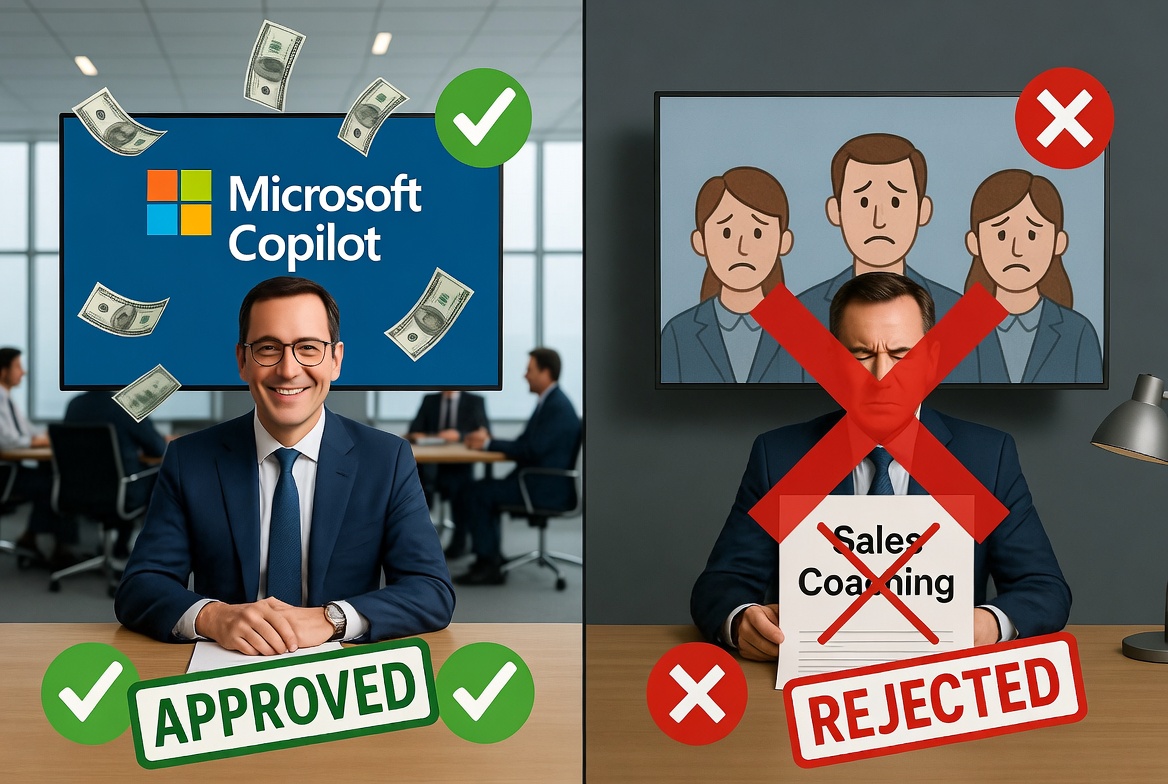
The answer reveals more about your philosophy, culture, and future growth trajectory than any dashboard will.
A few weeks ago, this post went viral on X: https://x.com/gothburz/status/1999124665801880032
Although I’m summarizing it in this paragraph, you should read it for context.
An executive rolled out Microsoft Copilot to 4,000 employees at $30 per seat per month — $1.4 million a year. He branded it “digital transformation.” The board approved it in eleven minutes with zero questions about ROI or results. Three months later, almost nobody was using it. So he fabricated glowing metrics, created an upward-sloping graph, got the company featured in Microsoft’s case study, expanded the rollout to more 5,000 more employees for even more spend, and positioned himself for a promotion.
The whole thing wasn’t about productivity. It was about signaling — looking visionary without having to admit anything was wrong with the current operation.
How would this play out in the sales organization?
The same companies that eagerly rubber-stamp seven-figure AI spends do a complete about-face when the investment involves salespeople, sales effectiveness, or sales improvement initiatives.
They fight tooth and nail against far smaller investments in sales team evaluations, candidate assessments, sales training, sales leadership development, coaching, or consulting.
Why the about face?
Because investing in real sales effectiveness requires admitting weakness, and most sales leaders have big egos. Admitting the team isn’t performing at the level they’ve been directed to achieve, or what they promised to deliver, feels deeply personal.
There’s also a fundamental misunderstanding of the role. The CRO, Senior VP of Sales, and often their boss, believe they are personally supposed to handle all training, coaching, and development themselves. It’s so strange! Nobody expects the CFO to do the company’s tax returns and audits, so why would anyone expect the Senior Sales Leader/CRO to do the sales equivalent of that?
On top of that, we often hear the same delay tactics:
- “This is important… but not right now. We have too much going on.”
- “We don’t have the money right now — sales are down.”
If only they could hear what they actually sound like. When sales are down is exactly when they need the help – even more than other companies! They’re quietly admitting the revenue engine is struggling, yet they want to delay the very thing that could fix it until the problem somehow corrects itself. Can you image delaying the repair/replacement of a leaky roof? Dead water heater or furnace? Seized car engine? Fallen Tree on your home or building? IRS Audit? Lawsuit? Root Canal? 4 Blocked Arteries (that one’s personal)? Cancer?
Don’t get me wrong — I’m not whining or complaining. We have plenty of clients, from companies of all sizes in more than 200 industries, that appreciate us and invest in our help. But I have a reputation for pushing leaders out of their comfort zone. I’m pretty relentless and consistent about it, and this feels like one of those opportunities to do it again.
Here’s the thing leaders rarely talk about, yet every company that opts out of sales training or coaching should hear:
Every company has a worst salesperson — or in many cases, worst salespeople.
This even applies to solopreneurs.
The real question is: Can that salesperson (or those salespeople) become a producer… or are we left with only two other options?
➡️ Terminating them
➡️ They continue being your weakest performer(s)
What would it cost — and more importantly, what would it be worth?
Have you ever watched the real-estate show Love It or List It? A home designer renovates the current house, hoping the owners fall in love with it all over again, while a realtor tries to convince them to sell it and buy a new home instead. The designer and realtor compete to win the homeowners over.
Sales leaders face a very similar three-way choice with a struggling rep (or reps):
➡️ Renovate (fix and develop them)
➡️ Replace (go through the costly hiring process)
➡️ Stay Put (do nothing and keep living with the ongoing drag on revenue and team morale).
SaaS Math: Save an Awful Salesperson
Investment: $7,600 per salesperson for a structured 6-month coaching program (evaluation, customized plan, bi-weekly coaching and reviews).
This also makes an excellent low-risk pilot. Coach your weakest performers while the rest of the team serves as a natural control group. You can then run a legitimate A/B comparison and measure the percentage increase in pipeline, revenue, closed deals, or conversions between the Kurlan-coached group and the non-coached group.
Target outcomes (additional net gross profit per salesperson):
| Avg Net GP per Sale | Break-even | Good (3X) | Strong (5X) | Great (10X) | Monthly Pace (for 5X) |
|---|---|---|---|---|---|
| $5,000 | 2 total | 5 total | 8 total | 16 total | 1.3 / month |
| $10,000 | 1 total | 3 total | 4 total | 8 total | 0.7 / month |
| $15,000 | 1 total | 2 total | 3 total | 6 total | 0.5 / month |
| $25,000+ | 1 total | 1 total | 2 total | 4 total | 0.3 / month |
Note: Net GP per sale = profit after paying the salesperson’s commission on the new sales. Monthly pace is averaged over 6 months and rounded.
Key conditions for success:
➡️ Sales cycle must be shorter than 6 months (or coaching must be greater than or equal to sales cycle length)
➡️ There must be enough runway left before you terminate
➡️ The salesperson(s) must be coachable (uncoachable underperformers should be terminated)
➡️ A designated senior sales executive must hold them accountable for change
A results-based guarantee removes your risk — if the rep doesn’t at least break even, the coaching fee is refunded.
Would you rather make a modest investment to renovate your current rep(s)… or spend the $150,000+ (hard + soft costs) that most companies actually incur to recruit, onboard, and ramp up a replacement?
Love it or list it!
Of course, doing nothing has its own very real and usually much higher, long-term cost.
The bigger question for every CEO and sales leader:
Are we investing in what makes us look better… or in what actually makes us perform better?
The answer reveals more about your philosophy, culture, and future growth trajectory than any dashboard will.
If you’d like help with the coaching, running the numbers for your situation, or advice on what else you can do, feel free to send an email.