
Why Your Sales Team Needs Veteran Story Hour: Lessons from the Red Sox
- April 4, 2026
- Posted by: Dave Kurlan
- Category: Understanding the Sales Force
The Baseball Analogy
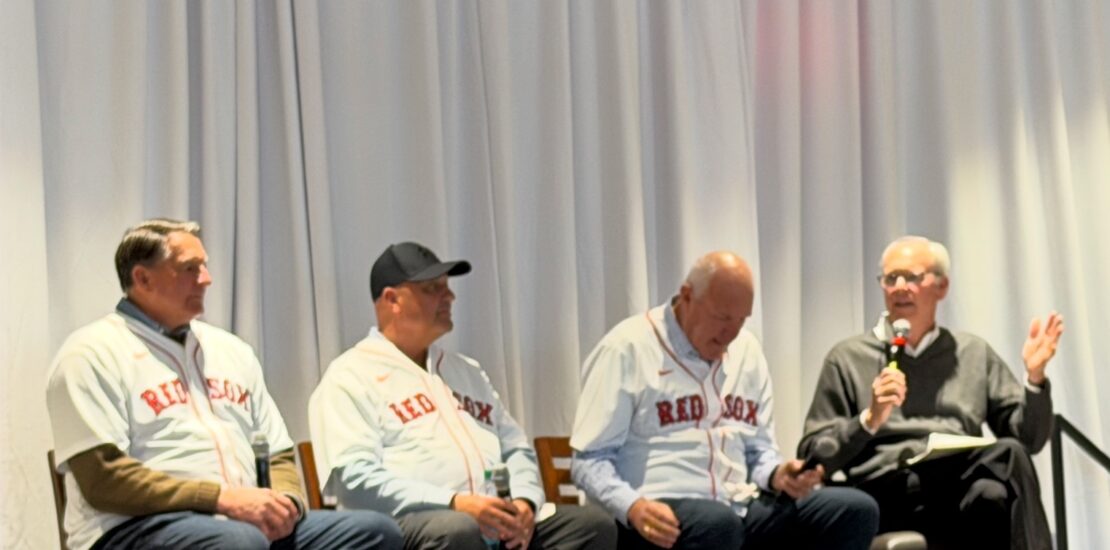
My wife and I were guests at an event featuring 3 players from the 1986 American League pennant winning Boston Red Sox. It was nostalgic. It was fun. Pitchers Bob Stanley (Steamer) and Bruce Hurst, along with shortstop Spike Owen told meaningful, memorable and hilarious stories to the appreciation of those who remember the devastating emotional ending to the 1986 World Series.
The Sales Analogy
Why don’t sales organizations ask their best, most successful, veteran and/or retired salespeople to spend an hour sharing meaningful, memorable and even hilarious stories with their current, younger salespeople?
It doesn’t involve any of the elements that prevent people from changing:
- It doesn’t cost anything.
- It’s not difficult.
- It’s not scary.
- It doesn’t take a long time.
People love hearing good stories:
- They are entertaining.
- They break up the monotony of the grind.
- They create cultural transmission of tribal knowledge that no manual can match.
- They are educational.
- They are memorable.
- The story-tellers are credible.
- They reinforce best practices.
Just as those 1986 players passed down war stories that made the pain and glory real, veteran salespeople can pass down the plays that actually win deals. My 2005 best-seller, Baseline Selling: How to Become a Sales Superstar by Using What You Already Know about Baseball, has 16 stories to help reinforce important points.
95% of the sales consulting and training work we do is in B2B but my first sales job was B2B – selling Cutco knives to people in their homes. I will never forget the first call I went on with the big boss because his approach was the complete opposite of what I had been taught by my local boss.
The Story
We called on an eighteen-year-old girl who lived with her mother in a four-room apartment of a depressed 6-unit building. I noticed that Bob didn’t have his samples but figured he wouldn’t need them, because this girl could not possibly afford a $250 (1974 prices) set of knives—never mind cookware, flatware, or china. I was sure she and her mother were destitute.
We sat down at an old, gray, plastic-topped table with metal legs. Although Bob did talk with the girl, he spent most of his time talking with her mother. He asked her to make coffee, then cookies, and then complimented her baking.
We were there for 45 minutes, and Bob hadn’t even started! He finally asked the girl some questions—but they had nothing to do with knives. “Would you like to get married?” “Would you like to have a family?” “Will you want nice things?” “Have you started putting things away?” “Do you have a hope chest?” “What’s in there?” “Are you helping her, Mom?” “If you found something really special and you really wanted it, could you put aside $10 a month?” That’s not what I was taught to do.
Finally, he sent me to get his samples. He opened them, but never explained, demonstrated, built value, or shared any any of the templated features or benefits of the knives. He just opened the display and sat there looking at them as if they were made of gold.
The girl’s boyfriend knocked on the door, entered and asked, “Who are they and what are they doing here?”
The girl very nicely replied that “these boys are showing me some nice knives for when we get married.”
“You don’t need that shit,” he said.
We were about 10 seconds from being back in the car, perhaps with bruises to show for it.
Bob turned to her mother and said, “These punks are all the same today. All they want to do is get in your daughter’s panties.”
I didn’t think it could get any worse, when her mother said, “You’re right! I want you out of my house!”
The punk replied, “Baby, you gonna let her talk to me like that?”
The girl said, “She’s right. Get out!”
I had been 100 percent wrong about everything that had happened. But even as I began to sense that Bob knew what he was doing, I couldn’t have predicted what would happen next. Mom said, “I don’t know how much you sell those knives for, Bob, but I’d like to get a set for my daughter…and another set for me.”
Bob said, “Of course. You are one sharp cookie and a hell of a baker, too. The two sets come to just $500. Do you have that under the mattress?”
The mother said, “Oh, Bob. You know me like a book. Follow me to my bedroom and I’ll show you where I keep the money.”
He followed, she lifted the mattress, took out a wad of cash, peeled off $500, pinched his cheek, thanked him for coming, made us finish the cookies, and wished us well.
The Lessons
Bob’s call was ninety percent bonding and rapport, a dozen or so qualifying questions, no presentation, and he sold two outrageously priced sets of knives to a mother and daughter with no creature comforts to their name. If you were on that call, would you have sat up and taken notice? I sure did—and it changed how I approached every sales call afterward.
There were so many lessons about what you can actually say and ask, how to change call dynamics, how to capitalize on an interruption, the relative unimportance of jumping straight into presentations, demos, quotes and proposals, and the timing of what you do and when you do it. More importantly, he was following an internal sales process, which he later shared with me.
My innovations in selling, training and coaching evolved a lot in the 30 years between that 1974 sales call and the birth of Baseline Selling in 2005, but even more so in the 20 years between the book launch and today. Make no mistake, an effective repeatable, predictable sales process is a game changer. That said, sales process without supportive Sales DNA, Commitment, and a closet full of tactical selling competencies will only get you so far. It is also important to recognize that an effective sales process is a complete sales process. Otherwise, it is like forgetting the sugar and putting the crust in the middle of a pie. It won’t look or taste like pie. It will suck! Sales process needs to be staged, milestone-centric, buyer-focused and properly sequenced – no crust in the middle.
Be like the Red Sox! Bring back your former salespeople to tell their stories.
Want to optimize your sales process with a custom scorecard that aligns with your unique business? Let us help you. It’s a total positive game-changer for all.