
- June 23, 2026
- Posted by: Dave Kurlan
- Categories: Analogies, Sales Pipeline and Forecast, Understanding the Sales Force
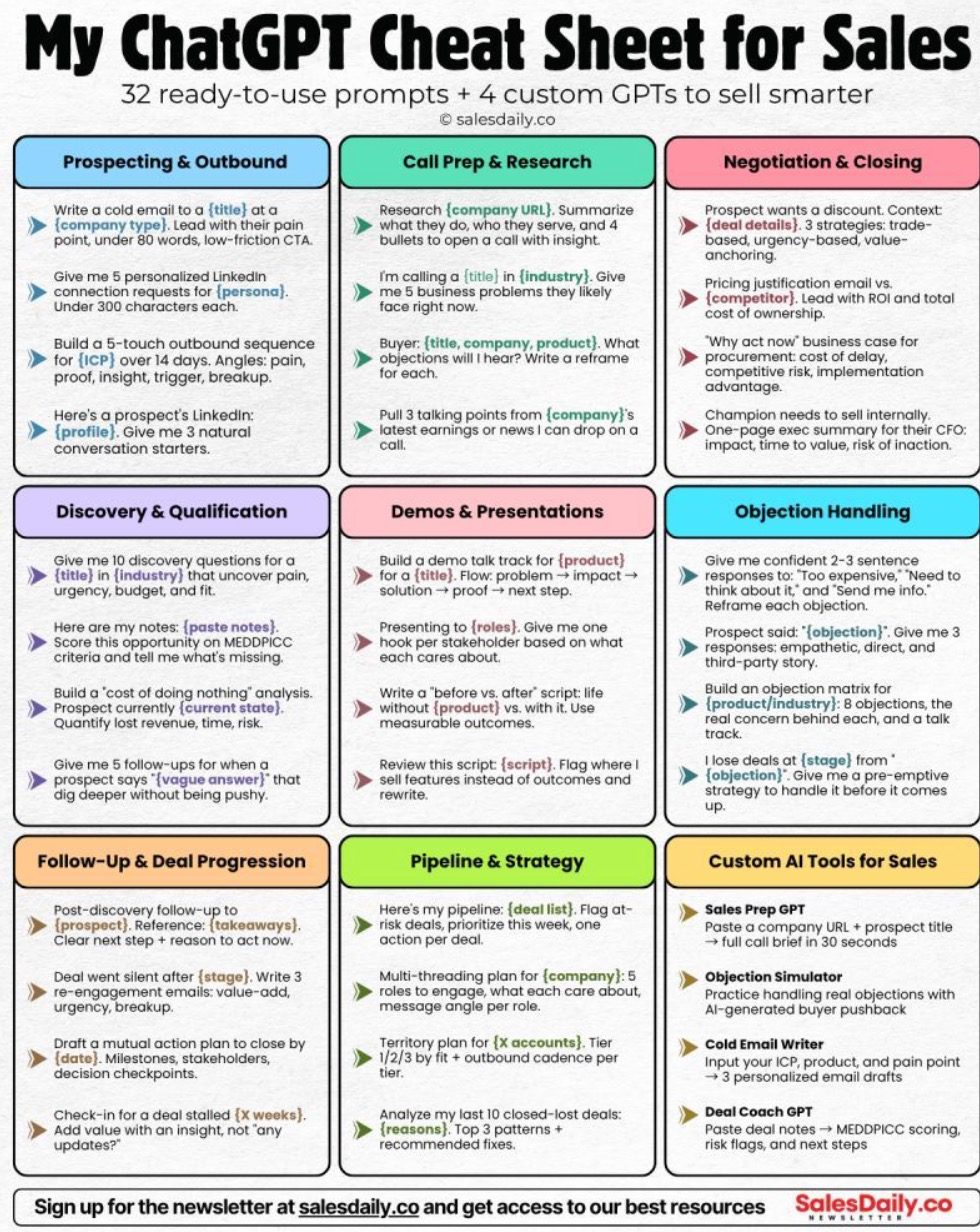
You’ve probably seen the SalesDaily.co posts blowing up on LinkedIn lately.
This drops a 32-prompt cheat sheet for ChatGPT that promises to handle everything from 5-touch outbound sequences to scoring opportunities on MEDDPICC, rewriting demo scripts, and flagging at-risk deals in your pipeline.
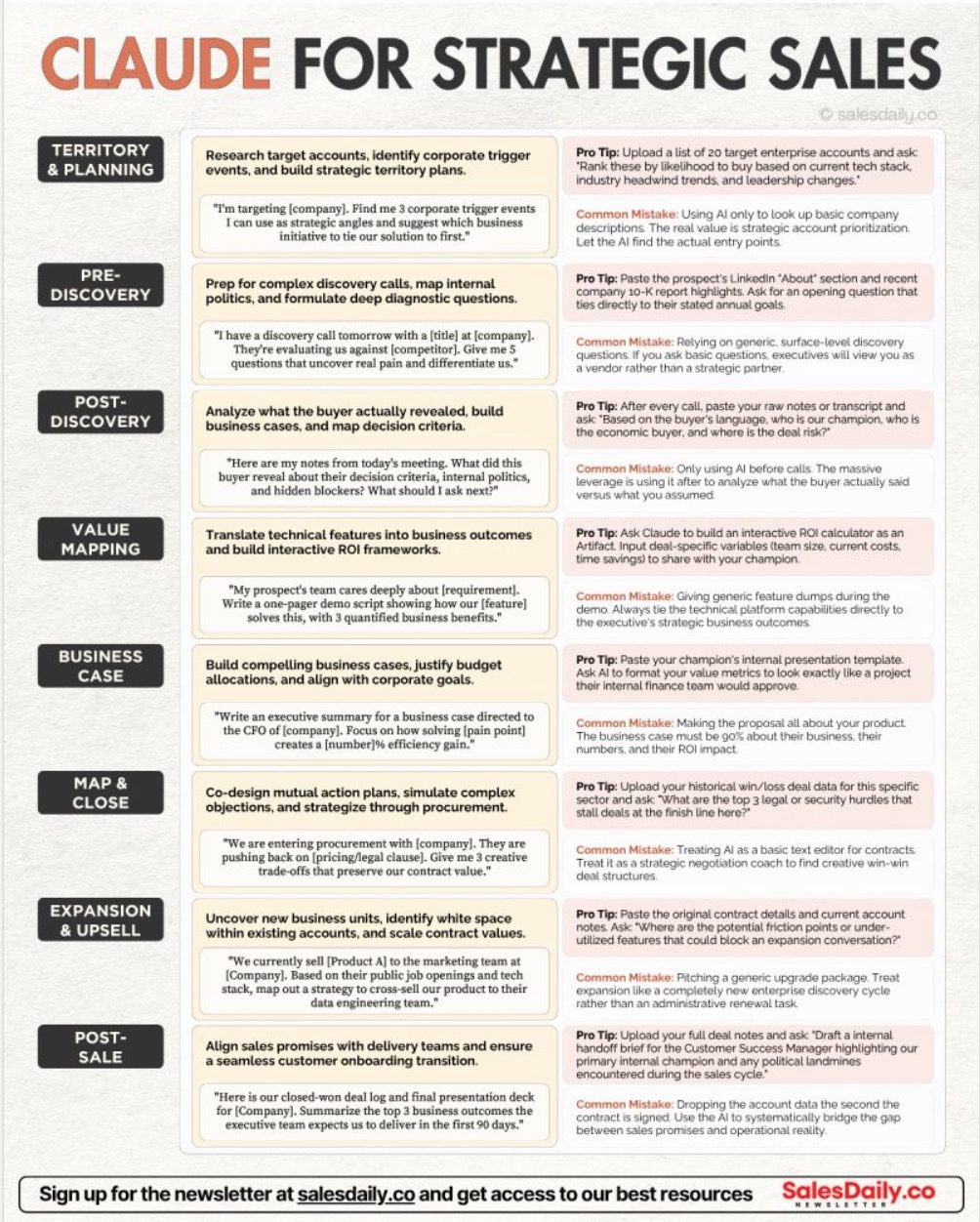
This one hands you the exact Claude prompt for every single stage — territory planning, pre- and post-discovery, value mapping, business cases, negotiation, expansion, even post-sale reviews.
The message in both is the same: prompt smarter, cut the busywork, and you’ll win.
Here’s the part they’re not highlighting: when every salesperson starts using the same prompts, every salesperson starts sounding exactly the same. No differentiation. You know this is true! You’ve seen the cloned AI outbound messaging in action. Every company sending the same crappy, deletable, unreadable, horribly personalized emails and LinkedIn direct messages and getting little to nothing for their efforts.
Prospects are already living through the latest attempts. They’ve sat through five discovery calls this week where the rep asked the identical “strategic” questions about internal politics, hidden blockers, and decision criteria. They’ve heard the same three ready-made responses to their objections — empathetic, direct, and the third-party story. The business case that was supposed to be “90% about their numbers” somehow started sounding a lot like the one from the rep who called yesterday.
Prospects spot it. Fast. Pattern recognition. The way they used to see a traditional close coming. Impending events like, “The price goes up on Monday.” “Here’s a pen.” “Would you like it in red or blue?” “Would you like 12 dozen or 6 dozen?”
It’s just like a veteran batter who knows the breaking ball is coming before the pitcher goes into his windup.
It’s the sales version of every hitter in the league doing what young baseball players do in the mirror every day; Copying the exact same stance and swing from their favorite hitters. By the third batter, pitchers are throwing breaking balls away and watching the clones chase pitches outside the strike zone.
More importantly, and this is what actually determines whether any of this moves the needle, how effective are you when you are having conversations with your prospects?
Even if AI hands you the perfect output with fresh context pulled from your CRM, LinkedIn, and past notes, you still have to deliver it in the moment. You still have to read the micro-reaction when you ask that “perfect” question. You still have to hear the real concern behind the stall, adjust your messaging on the fly, find the urgency that doesn’t feel manufactured, and know when to push versus when to pull.
The prompts don’t build that muscle. They don’t fix your need to be liked, that makes you accept a put-off. They don’t develop the killer instinct to work through objections. They don’t teach you to stay in the moment instead of thinking three questions ahead. As a matter of fact, the prompts make it worse. You’ll never be in the moment when you’re trying to remember the next question that – whoops – you’ve already asked. What happens after you’ve run through the scripted questions but you haven’t yet uncovered their compelling reason to buy? Now you’re on your own, and you should have been on your own from the opening question.
That’s why the bottom 74% stay in the bottom 74%. They’re getting better at sounding smart on paper, but the actual conversations still expose the gaps. The elite 6% use tools to augment what they already do well. Everyone else is just getting more efficient at being average or worse. Who wants to be the tallest midget?
The reps who are actually pulling away aren’t the ones with the best prompt libraries. They’re the ones getting real, personalized feedback on their actual calls. Feedback on what they said, how the prospect responded, and what the salesperson said or asked in response to that. Feedback on the better response, why it matters, and exactly which Baseline Selling principle it ties to.
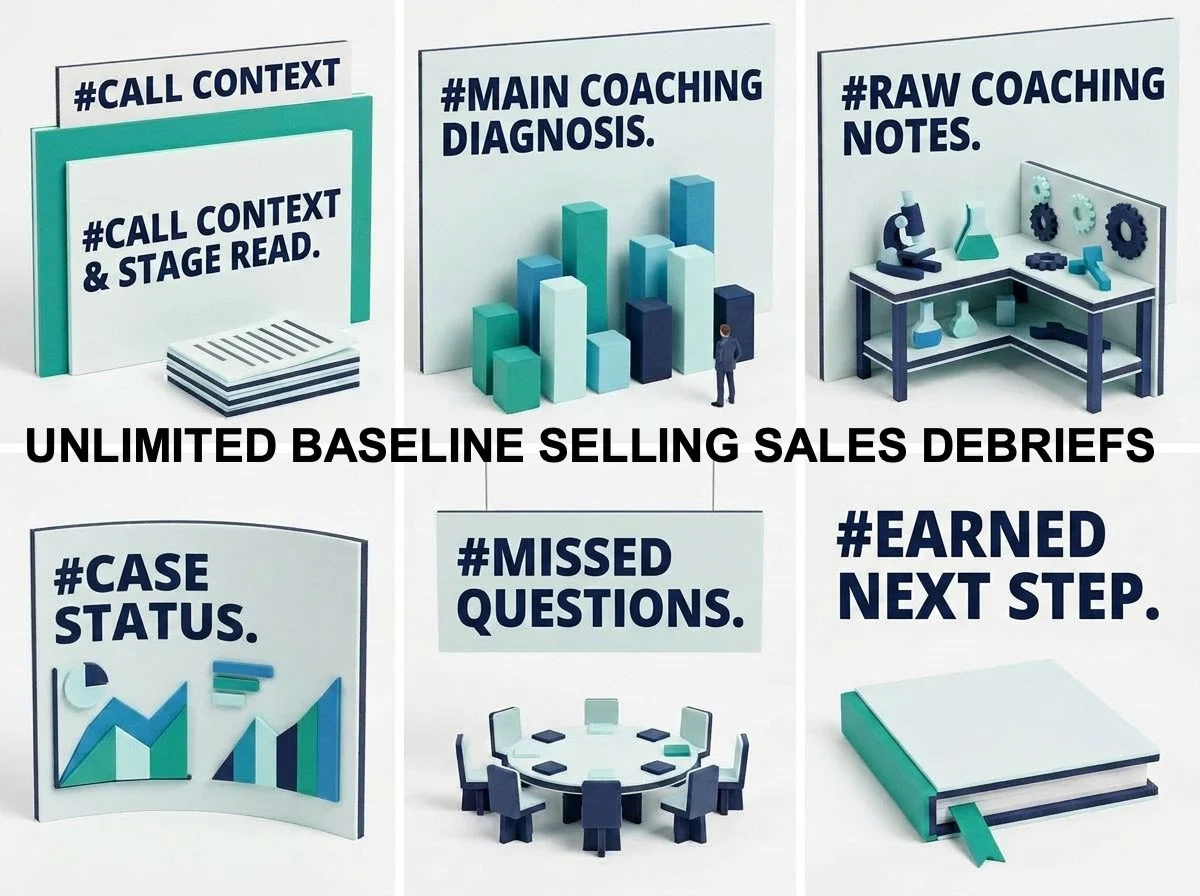
That’s what our unlimited sales debriefs delivers.
You may be recording all of your phone conversations. Even if your company doesn’t have an app such as Gong that records your conversations, you can use a device like Pocket which records your conversations even if you’re on the road and face-to-face with a prospect.
You have the recordings, but does your sales manager have the time to listen to your calls? Even if they do, very few sales managers can provide on-the-mark, detailed feedback that you deserve. Not stats and data, but usable feedback on what you did well, what you missed, what you could have done better, what you could have done differently, the exact moment in the conversation where you missed an opportunity to ask the perfect question, etc.
For $250 a month you get unlimited sales debriefs (recordings or transcripts) in the style you’ve come to expect. Timestamped breakdowns. Structured the way it needs to be: Prospect said this. You responded with that. Here’s the better response. Here’s why it matters — tied directly to the Baseline Selling sales process and methodology as well as the 21 Sales Core Competencies that actually move the needle.
It’s not another generic AI coach giving the same advice to everyone. It’s coaching on your words, your timing, your specific prospect situations. Like having a coach who breaks down the video from every one of your at-bats from today’s game, shows you the pitch you missed and the adjustment you need before the next game.
Instead of joining the clone army that’s all running the same prompts, you start developing the real skills that make prospects say, “Finally, someone who actually gets it.”
If you’re tired of sounding like everyone else and ready to actually get better, this is the move.
Check it out, request a sample report, start a free trial, at https://www.kurlanassociates.com/unlimited-sales-and-sales-coaching-debriefs/.