
- September 21, 2026
- Posted by: Dave Kurlan
- Categories: Analogies, Music and Sales, Understanding the Sales Force
We were in Boston’s North End, first time at a restaurant called Arya. The owner welcomed us to his “home” and suggested we let him select and bring the food so we wouldn’t have to make menu decisions. He asked, “Do you trust me?”
How are you supposed to answer “No” to that question? And if you do say no, then what — the staff spit in your food because you don’t trust the owner? So we said, “Of course!” and away we went. Ten courses of delicious food until we couldn’t eat anymore.
It’s an upsell. That’s how he has always done it, and he knows it works. He won’t change it because it isn’t broken.
Earning the prospect’s trust is the end game in sales too, with two exceptions:
- Don’t ask if they trust you
- Don’t close on trust in the first minute
He can ask because the food is coming. You cannot.
Which brings us to what we change, and what we should have left alone.
Over the weekend I heard Barry Manilow’s Very Strange Medley for the first time since the 1970s. Before the hits, he wrote and sang some of the stickiest jingles ever cut. Two of them were so good the companies left them alone: Band-Aid (“I am stuck on Band-Aid, ’cause Band-Aid’s stuck on me”) and State Farm (“Like a good neighbor, State Farm is there”). State Farm is still using that melody more than fifty years later. It wasn’t broken.
McDonald’s couldn’t sit still. “You Deserve a Break Today” worked. Then came “I’m lovin’ it.” Now it’s the leftover hook: da-dum da-da-da. A working jingle, and they still poked it.
Listen to the entire medley here.
Sales has the same split. Some upgrades were fantastic. Some things should have been left alone. And one upgrade everybody claims they made never actually happened.
| Original | Upgrade | Verdict | Adoption | Comments |
|---|---|---|---|---|
| Horse | Car | Real upgrade | Complete | Nobody is lobbying to bring the horse back. Territory, speed, and range changed. |
| Pay phone | Cell phone | Real upgrade | Complete | You stopped carrying dimes and looking for a booth. The upgrade was access. The hang-up, the screen, and “who is this?” came with it. |
| Any phone | Email / text | Not an upgrade | Near-universal as a channel — and that’s the problem | Caused salespeople to hide behind keyboards and call it selling. |
| Paper map / MapQuest printout | GPS in the phone | Real upgrade | Universal among drivers with a phone | You don’t unfold a map on the hood in the rain. Salespeople still run calls with no process and call it flexibility. |
| Travel agent + paper ticket | Book-it-yourself apps | Real upgrade | Dominant | Convenience won. The sales fantasy version is “they’ll find us.” They still won’t diagnose themselves. |
| Phone book / Yellow Pages | ZoomInfo | Tool upgrade, behavior split | Seats are common in B2B; disciplined use is not | The phone book got you to dial. ZoomInfo too often gets you to spray. |
| Rolodex / notebook / spreadsheet | CRM | Bought, not adopted | ~91% of companies with 10+ employees have one; consistent rep use often 27–36% | Paid for it. A third of the team lives in it. The rest keep a shadow spreadsheet and update Friday. Executives over-report usage. |
| Attached agreement / wet ink / FedEx | DocuSign | Real upgrade | High in business | “I’ll mail the contract” died. “Legal still has to look at it” did not. The tool shortened the last mile. It did not qualify the deal. |
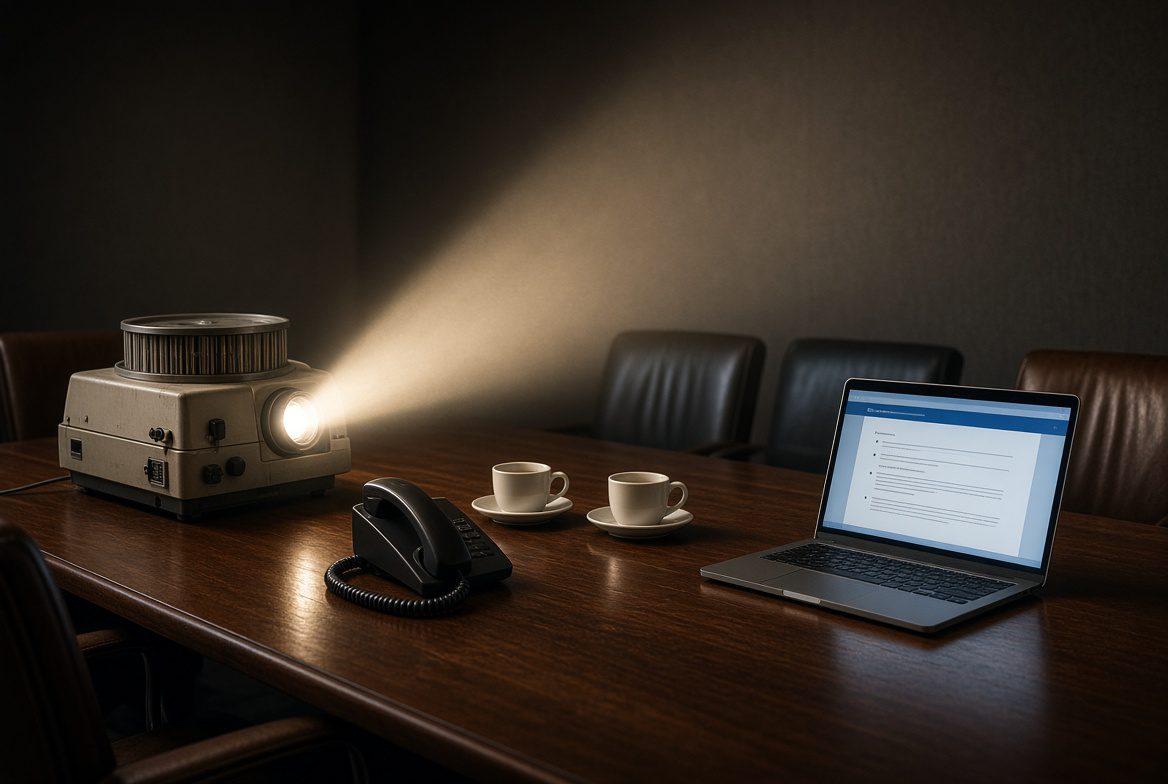
| Slide carousel / overheads | PowerPoint | Tool upgrade that protected the old habit | Near-universal in sales | The carousel was clumsy, so people presented less or later. PowerPoint made presenting cheap, pretty, and early. The tool upgraded. The timing got worse. |
| Feature dump / demo first | Diagnose first (consultative) | Real upgrade, mostly refused | 17% strong in Consultative Seller | They upgraded the slides and kept the pitch. “We sell consultatively” is a brand claim. 17% is the competency. |
| Pipeline as names and hope dates | Opportunities in stages with milestones met | Real upgrade, rare | Most teams have stages; few have milestones with teeth | CRM gave them columns. A stage named Proposal is not evidence anyone uncovered a reason to buy. |
| Inbound / buyer-journey as the process | Inbound as a lead source | Fake upgrade / hall pass | High as a belief; 17% can still sell | They adopted a story that excused them from the conversation. |
| AI writes the email / summarizes the call | AI as a faster assistant after the conversation changes | Incomplete | Tool use is common; revenue impact is not | Faster junk is still junk. |
The one everyone should have left alone was replacing the phone with anything other than the phone for having sales conversations. Email and text are fine for updates and sending attachments. You cannot have a conversation, stay in the moment, and complete it now over a keyboard.
PowerPoint is checkmate over the slide carousel.
CRM replaced notes, 3×5 cards, and the Rolodex — three separate things stored in three physical places.
That brings us back to the sales conversation.
Transactional selling is not one of the good, memorable things we should have kept. If you can read a math equation, read it this way:
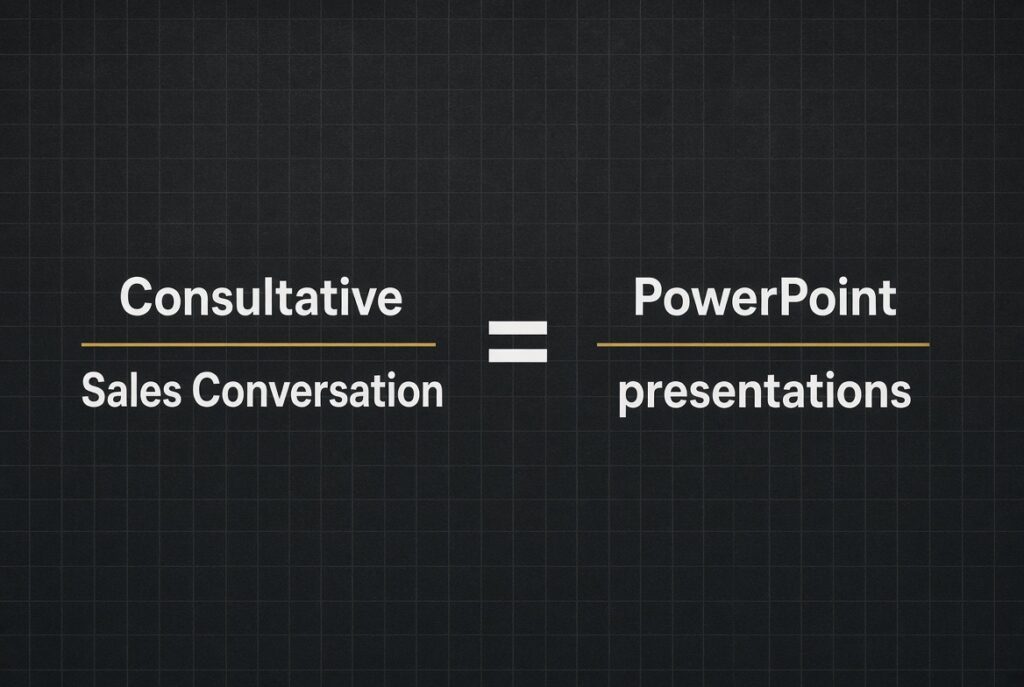
That is: a consultative approach is to the sales conversation as PowerPoint is to presentations. PowerPoint is the upgraded way to present. Consultative is the upgraded way to sell. People adopted the first and refused the second. The equals sign is not permission to treat the conversation as a deck.
You aren’t using cameras with film, sending it out to be processed into slides, loading an electric carousel, and hoping the bulb doesn’t blow. You’re building a deck in PowerPoint — or having AI knock one out. It’s more powerful, more flexible, goes anywhere, can be sent over email, and gives you control of the presentation.
So why are you using the PowerPoint too early instead of asking great questions, listening, and having a real conversation? That’s how you uncover compelling reasons to buy from you. They’ll buy because of their compelling reasons, not because you are PowerPoint proficient.
The owner at Arya asked, “Do you trust me?” when he could prove it immediately. That’s not minute one with your laptop open. That’s what the conversation is for. Earn it. Then you can run the table.