- July 9, 2026
- Posted by: Dave Kurlan
- Categories: Analogies, Politics and Sales, Understanding the Sales Force
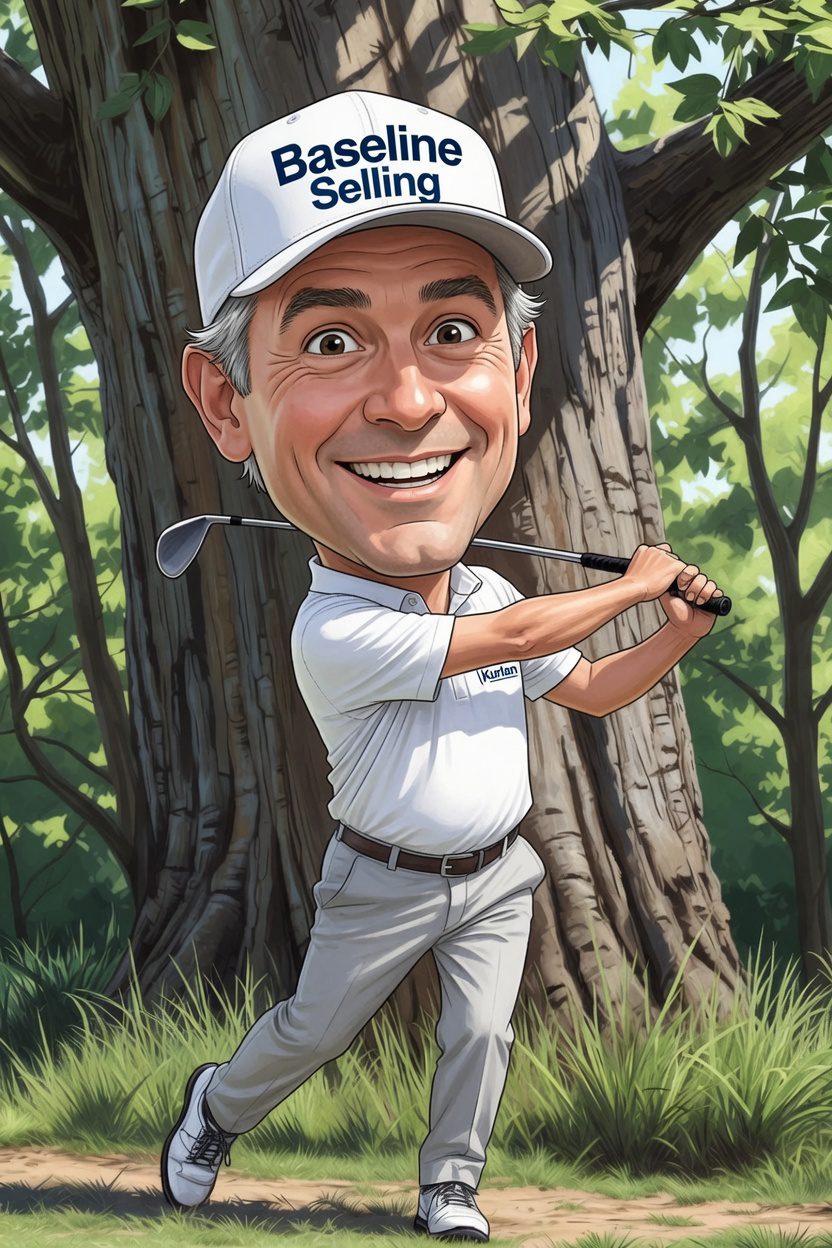
Dave the Golfer
I’m not a very good golfer.
I can hit my drives a good distance but they rarely land in the fairway. I can hit my irons straighter but they still don’t go where I want them to. My approach shots to the green are worse and way too frequently I’m 3-putting. So, while I can get up and down, and recover from horrible shots, I don’t score very well because of my short game.
If I could go from 3 putting to 2 putting, that would shave 18 points off my score. That would be an Exponential improvement! To achieve that I would only have to work on a single thing. Putting. Every day. From every angle. Get a feel for the distance and the resulting putting stroke. Work on my aim. Learn to read the greens. Rinse and repeat. If only I had the time!
On the other hand, if I worked on my drive and hit 9 fairways instead of 6, that would be Incremental Improvement and more importantly, it might not reduce my score at all. It would probably take as much time to improve as the putting but with a lesser return.
It’s like a baseball player who gets obsessed with launch angle and exit velocity, but forgets he needs to work on reaching base more consistently.
The Sales Equivalent
Just like me on the golf course, most salespeople don’t work on anything to actually improve. Those in corporate sales training programs usually show up, but many skip the hard part, the deliberate practice, behavior change, and consistent implementation that actually moves the needle.
If forced to choose, most would rather polish their presentations, slide decks, proposals, and closing techniques. Those activities feel productive, but they have limited impact on the decision-making process. At best, they deliver Incremental Improvement with little lift in win rate.
The activity with the biggest payoff is filling the pipeline. A salesperson with a 50% win rate who doubles the number of opportunities in the pipeline will still close 50%, but they’ll double their sales. That’s Exponential Improvement. Of course, it requires doubling the proactive outbound effort: twice the dials, twice the conversations, and twice the meetings booked. The price is straightforward; twice the time and discipline.
Lucrative Cross Improvement
We’ve looked at pure incremental and pure exponential improvement. But what if you could get a 33% revenue increase (exponential) by making just 10% improvements (incremental) in three key areas? That’s exactly what the image below shows.
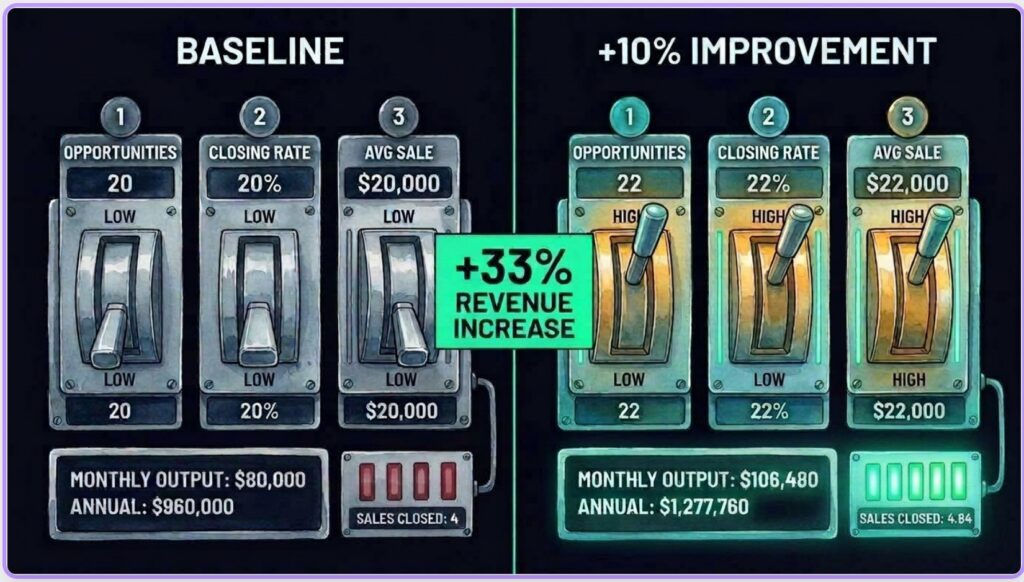
What would it take to find 10% more opportunities? Ten percent more consistent prospecting effort and time.
What would it take to increase your average sale by 10%? Getting better at selling value and confidently asking for more.
What would it take to improve your win rate by 10%? Getting stronger in two critical areas:
1. Discovery – The Consultative Approach
- Listening — Actually shutting up long enough for the prospect to talk.
- Questioning — Asking the tough, timely follow-ups that most salespeople avoid.
- Uncovering Compelling Reasons to Buy — Going beyond surface symptoms to find the real business and personal impact.
- Differentiating — Showing why you and your solution stand out once you truly understand their situation.
- Monetizing — Quantifying the cost of the problem or the value of the opportunity.
- Creating Urgency — Helping them feel the pressure of delay by asking the right timing questions.
2. Qualification
- Commitment to solve the problem or seize the opportunity
- Reaching actual decision makers
- Qualifying on value and willingness to invest more with you
- Alignment on timeline, decision process, and criteria
- Fit and capabilities on both sides
Consultative Critique
When I talk with prospective clients, they often tell me, “We do a pretty good job being consultative.” I’ve learned that most teams are nowhere near as good as they think. Salespeople typically stop after a couple of surface-level questions reveal a symptom, but never reach the real problem, the compelling reason to buy what they sell, or the compelling reason to buy it from them. Then they jump straight to presentation mode and wonder why they’re not closing more business.
Most sales teams need serious work here. Qualification feels easier to them — until they try it. If they skipped proper discovery, the prospect isn’t ready to be qualified and quickly gets annoyed.
On a scale of 0–100 — where 100 means your team is elite at both discovery and qualification, and 0 means you’re starting from scratch — where are you today?
The best way to find out is with an objective sales team evaluation. The results show exactly where your team stands now, and what it will take in terms of targeted training and coaching to move you from your current baseline to 80 or higher. The bar depends on what you sell, your price point, the competition, and the length of your sales cycle. Complex sales need higher capability. Simpler ones don’t.
You can check out samples of a sales team evaluation here.
Download our white papers here.
You can reach out to us for help here.

Beylikduzu Korsan Taksi