
- July 20, 2026
- Posted by: Dave Kurlan
- Categories: Analogies, Baseball and Sales, Sales Pipeline and Forecast, Understanding the Sales Force

We were at Fenway Park a few times during the Red Sox recent long winning streak where they completed 4 consecutive series sweeps. Three of the teams they swept were the first place Yankees (now in 2nd place), White Sox and Rays. I wrote about the Red Sox turnaround and how that applies to a sales turnaround a few weeks ago in this article.
For two games we were seated in the 3rd row along side third base for big wins over the Yankees and Orioles, and up in the 4th row of the pavilion for the win clinching the sweep over the Rays. The views couldn’t have been more different.
This is the view from our seats in the 3rd row where close proximity allowed us to be part of the action.

This is the view from our seats up in the pavilion where distance allowed us to overlook all the action.

Notice the distinction from part of the action versus overlooking the action. From close up, a ground ball to short traveled a very short distance while the same grounder to short from our pavilion view seemed to travel much further. Same with fly balls. From the field seats, you could how well it was hit but from the pavilion you could see how far it would go.
Here’s another example. I took a picture of a fence.
Fom the distance the fence appeared fine – in good shape.

This is the fence close up. Up close you could easily see the crud all over the surface.

Just like that fence, when you’re right in the middle of a deal, it’s easy to miss the big picture. You get too close to the opportunity and suddenly you’re focused on the surface-level stuff—the emotions, the hope, the “they really like me” feelings—instead of the real condition of the sales pipeline.
One of the topics that CEOs often deal with is their need to work ON the business instead of IN the business. There should be a corollary for sales where salespeople, and especially their sales managers, need to work on the deals in the sales pipeline instead of in the deals.
On the deals gives us the pavilion view, the view of the fence from the distance. It provides trajectory and objectivity. In the deals gives us the near field seats, the up-close view of the crud on the fence. We are too close to the opportunity to address it without emotions and feelings. There’s a problem with that! In the movie, “A League of Their Own,” Jimmy Dugan, the manager of the all-girls baseball team, played by Tom Hanks, says, “There’s no cryin’ in baseball.” Well, there’s no feelings in a sales pipeline review.
The sales pipeline review must be facts-based, not emotion-based. Events and next steps, not feelings. Milestones and accomplishments, not sentiment.
When sales managers allow salespeople to express their feelings they are provided with editorials, spin, bias, hope, and false dates, values and likelihoods.
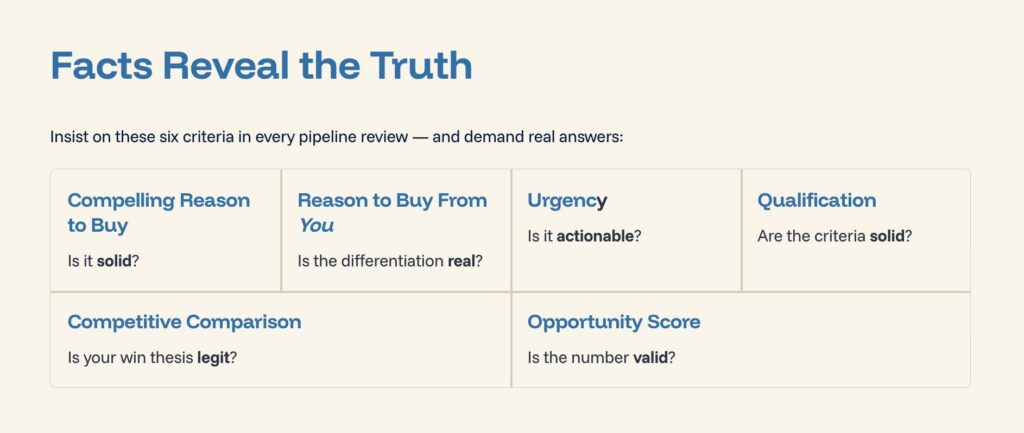
When sales managers ban feelings, and rely on facts only, they can determine if the compelling reason to buy is solid, the reason to buy from you is real, the urgency is actionable, the qualification solid, the comparison to the competition is legit, and the opportunity score is valid.
That kind of clear, objective view from the pavilion is exactly what turns pipeline reviews into powerful coaching moments. Most salespeople, when asked what they want to work on, say ‘I’m good.’ But when you review opportunities the right way—with facts, not feelings—the need for coaching stares right back at everyone.
The thing that most sales managers and salespeople miss about getting the facts about an opportunity correct, is the coaching that should occur naturally from a pipeline review.
Some of the most useful, powerful and productive coaching I do with salespeople occurs right after they say, “I’m good.”
In a recent conversation, a salesperson told me about all the new opportunities he had added to his pipeline and then said, “So I’m good.” He has a very short sales cycle so after congratulating him, I asked, “How many of them did you close?” He said, “None of them.”
He wasn’t good.
Instead, we had a very important coaching conversation where we worked on — you guessed wrong — not closing. Back then, he sucked at both discovery and qualifying. Over the next 12 coaching sessions, we focused on the listening and questioning required to be more effective uncovering compelling reasons to buy and creating urgency. After that we worked on his qualifying skills.
Closing rate when he was “good”: 10%. Closing rate after 12 coaching sessions: 65%.
Everyone needs coaching.
Lazy sales managers hope their salespeople say “I’m good.”
Good sales managers search for a opportunity to coach and there is no better place to find one than with what is sitting in the pipeline right now.
Most sales managers sit somewhere between lazy and incompetent as only 8% are skilled at coaching consistently and effectively.
If you need some help in this area, we have many ways to help sales managers become more effective at coaching up their salespeople.
The easiest way is our AI-assisted sales debriefs. Send us their call recordings/transcripts and we provide 3-5 page debriefs/coaching to help you help them. Learn more here.
We also provide live virtual, live face-to-face, self-directed and blended training and coaching for sales managers and sales leaders. Reach out to us to learn more.