
- August 11, 2026
- Posted by: Dave Kurlan
- Categories: Analogies, Baseball and Sales, Understanding the Sales Force
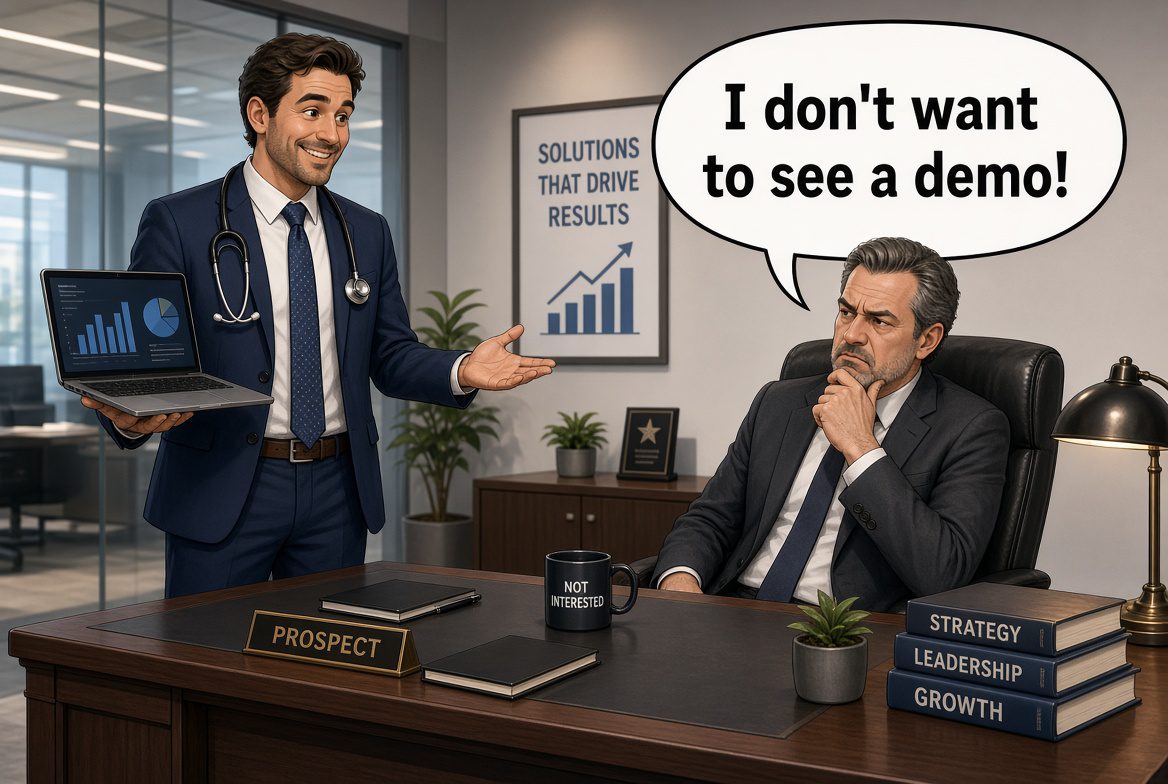
I am not only the Sales Analogy King, I’m also somewhat of a sales historian. Despite my thousands of articles with analogies to selling, there is a well-known analogy that did not originate with me.
I did not create the Doctor’s Visit as an analogy for Consultative Selling, but I am expanding it with a little help from my friends.
First, I’ll share the original analogy so that everyone is on the same page.
Larry Wilson, CEO of Wilson Learning Systems, created the first comparison circa 1970. This is the earliest commercial sales methodology that framed the conversation around “diagnosis before prescription.
Also in 1970, Mack Hanan coined and popularized the term “consultative selling” in his book by the same name. His language is full of diagnosis and prescription: the salesperson diagnoses the customer’s problem (usually in financial/profit terms), then writes a “prescription” for profit improvement. He treats the salesperson more like a doctor/consultant than a vendor.
Brian Tracy, the most well-known of the group, did more than almost anyone to put the full “Doctor of Selling” metaphor into the mainstream. He has used this clean three-part sequence for decades:
- Examination (ask questions / gather symptoms)
- Diagnosis (confirm the real problem with the buyer)
- Prescription (only then recommend the solution)
He frames it almost exactly like a medical visit and repeatedly says that jumping to the prescription without examination and diagnosis is malpractice. A lot of the modern “sell like a doctor” content you see floating around is either directly or indirectly downstream from Tracy’s version.
It’s a good analogy but it’s not new, so let’s renovate it, build an addition, and turn it into a luxury hotel, where salespeople can visit and use the analogy.
Recently, Adam Boyd posted on Linkedin and said:
“Think about the last doctor who spent real time with you before saying anything. You didn’t walk out of that office thinking they were withholding. You walked out thinking they were thorough. By the time you understand all of it, there’s nothing left to pitch. You summarize what they told you, ask how big a problem it is, and ask if they want help.”
Adam wrote about the Doctor from the patient’s perspective, illustrating that if you understand how comfortable the prospect is after taking this approach, you won’t be selling or pitching, you’ll be suggesting, prescribing and solving.
I thought we could take the analogy even further. I said:
“If the doctor did jump in early with a diagnosis (as salespeople like to do), I’ll bet dollars to donuts that the patient is hoping to hear some version of “You’re fine” versus “All of your arteries are blocked!” “No!!!!!
In sales, when you jump in too early with what might be the correct diagnosis and solution, it might be something your prospects aren’t yet ready to hear.
John Juhasz added some levity but made a great point when he said:
“If you went to the ER for what is likely a broken leg, would the Doctor tell you he has the most extensive colonoscopy equipment in the industry, and ask if you want a demo? The patient would say, “That’s cool doc, but I still have a bone sticking out of my leg…”
That’s a great example of what the majority of salespeople do. They run around looking for people who will agree to a demo for something they might not need, while probably having a problem that same salesperson could solve, if the salesperson only took the time to ask the right questions and have a normal, two-way, human-to-human conversation.
I interviewed a relatively strong salesperson who believes he takes a consultative approach. Compared with most salespeople, he does.
His version looks a lot like a doctor who asks, “Where does it hurt?” and then orders a couple of tests. That’s a start. But a real medical/consultative conversation goes much deeper. The follow-up questions sound more like this:
- Does it hurt to the touch or only when you move it?
- How long has it hurt?
- What were you doing when you first noticed the pain?
- Does it always hurt or just under certain circumstances?
- What have you already tried to help eliminate the pain?
- What happened then?
- Can you live with it or is it too painful?
- Is it interfering with your sleep?
- Have you had to give up doing anything?
- What’s worse: the pain, the length of time it’s been bothering you, or what you’ve had to give up?
- What about your friends and family?
- Have they grown tired of hearing you complain about it?
- Tell me about how all of that makes you feel.
That’s 13 questions. A consultative approach to selling will have even more questions.
Why?
Because when your prospects answer the sales versions of those questions, you’ll be listening to their responses and their answers create additional questions for you to ask as you dive for hidden treasure which, in this case, is their compelling reason to buy from you.
Taking a consultative approach is not easy. Based on Objective Management Group’s assessments of more than 2.5 million salespeople, only 17%, and just 1% of the bottom half, have the Consultative Seller Competency as a strength.
That’s pitiful!
Let’s use baseball, my goto analogy, as an example.
It’s not easy to hit a 100 MPH fastball, never mind the 5 other pitches that a pitcher might throw to a hitter. That’s why only the top 780 or so baseball players in the world get to play for an MLB team.
Each MLB team has 3-6 minor league teams with young players working their way up to the majors. That’s another 3,000-5,000 ball players trying to hone their baseball hitting skills. Because it’s so difficult, instead of standing in the batter’s box hoping to be walked or put in as a pinch runner, they are grinding. They aren’t taking short cuts.
But in sales, the vast majority of salespeople don’t even attempt a consultative approach. They don’t even try to ask questions, listen to answers, and have a two-way conversation to uncover a compelling reason to buy from them.
Nope.
They take short cuts.
They skip most of what must take place during Discovery and most of what they must validate during Qualification because it’s easier. Not more effective. Not more efficient. Not smarter. Not better. Easier. And in sales, short cuts and the path of least resistance lead to losses.
Why is the Consultative approach so difficult?
Salespeople become uncomfortable asking good, tough, timely questions, and their listening skills are for shit.
This is important!
A well-executed consultative approach leads to significantly higher win rates. A transactional approach that leans on demos produces stalled opportunities, delayed decisions, and unacceptably low win rates.
Is selling value important? Value selling depends on a rich consultative approach.
Is it important to generate proposals for only your fully qualified opportunities? Qualification depends on a Consultative approach.
Is it important to reach actual decision makers? Influencers and champions need a compelling reason to get the decision makers involved and that, too, requires a strong consultative approach. .
Most sales teams need far more help with these four competencies than with any others: Consultative Selling, Value Selling, Qualifying, and reaching Decision Makers. Mastering them is difficult. It is also a huge game changer.
When we combine focused training and coaching on these four competencies in the context of the Baseline Selling process, win rates routinely double.
If your team’s win rates suck or are stuck, you know where to find us.