
- October 23, 2026
- Posted by: Dave Kurlan
- Categories: Analogies, Sales Data and Science, Understanding the Sales Force

My wife mentioned a Harvard University study that found men who ate ice cream twice a week were less likely to develop diabetes. Now that’s my kind of study! I eat ice cream and don’t have diabetes—so there’s a personal correlation—but it clogged my arteries and I needed a quadruple bypass. I wonder if the other ice cream consequence is mentioned in the study…
The study was observational. The men who continued licking their ice cream were the ones who stayed healthier. The people who already had known risk factors or early symptoms had already cut back. The ice cream didn’t protect them, but it was a marker that they didn’t already have the underlying problem.
That’s the same trap most companies fall into when they look at their sales data.
Objective Management Group (OMG) has assessed more than 2.75 million salespeople and the patterns are clear. Certain competencies show up far more often in the top 5% of all salespeople than in the remainder of the sales population. That does not mean those competencies caused the results. Correlation versus causation. Check out the table below.
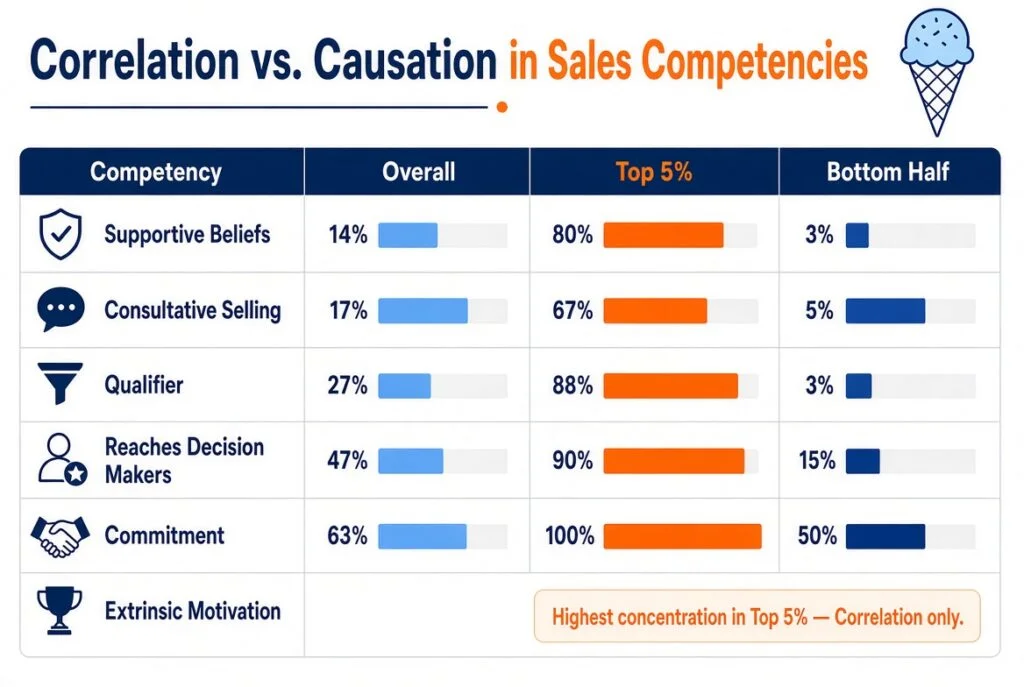
Extrinsic motivation is a clean example. It is the drive that comes from outside—money, status, winning the contest, the desire to look good. The largest concentration of people who are primarily extrinsically motivated sits in the top 5%. More correlation. Extrinsically motivated salespeople may still underperform if their Sales DNA or Tactical Selling competencies are weak. The motivation is obvious where the results are. It doesn’t produce the results.
Supportive Beliefs comes closer to causation. Only about 13–16% of all salespeople have supportive beliefs. Roughly 77–82% of the top 5% have them, and almost none of the bottom half do. When those beliefs are strong, your internal brakes are off, allowing salespeople to execute. When the beliefs are weak, people may know exactly what to do and still not do it. The absence of supportive beliefs reliably predicts the failure to execute, not just the absence of results. That’s closer to causation than simple association.
Consultative Seller follows the same pattern. Only 17% of all salespeople are strong at it. The breakdown shows about 67% of the top 5% are strong.
Qualifier is similar: roughly 27% overall are strong, 86–91% of the top 5%, and almost none of the bottom half.
Reaches Decision Makers sits around 47% overall and 90% of the top 5%.
All three tactical competencies as strengths are rare overall and heavily concentrated where the results live.
None of them is causal by itself. While many salespeople can describe what a thorough qualifying conversation or a full consultative process sounds like, what makes them causal in practice is their combination with supportive beliefs. The beliefs remove the brakes so the salespeople actually execute the skills early and consistently. Without supportive beliefs, the skills either don’t appear or appear too late to matter.
Commitment to Sales Success is the outlier in this conversation. It’s already present in a majority of the population—roughly 63%. It’s essentially universal among top performers. That makes it more of a prerequisite than a differentiator. Strong commitment alone, without the accompanying supportive beliefs or without the tactical skills does not produce elite results. Low commitment keeps people from doing the uncomfortable things even when they know how.
The ice cream parallel still holds. The people who already had the underlying problem (weak supportive beliefs) never did the things that look like success behaviors—reaching real decision makers, thoroughly qualifying opportunities, and running a full consultative conversation. The top 5% keep doing them because nothing stops them.
Most companies reverse the order. They train the skills and hope the results follow. That might work if we were discussing a train and the results were the caboose, but in sales the caboose doesn’t pull the train. The data says the skills only get used when the beliefs support the behavior. You can’t have the waffle cone until you eat the ice cream. Start with the brakes. Everything else becomes possible after that.
One challenge facing leaders is that they don’t have a way to measure beliefs, the Sales DNA they live in, motivation, or even the degree to which there are gaps in their salespeople’s Tactical Selling Competencies. Based on my personal experience evaluating thousands of sales teams, I can promise you that your sales team isn’t nearly as good as you think they are.
We can help you look under the hood, help you understand where the gaps are, what should change, how much more revenue your team is capable of producing, and how long it will take. You can reach us here.