
- June 6, 2026
- Posted by: Dave Kurlan
- Category: Understanding the Sales Force
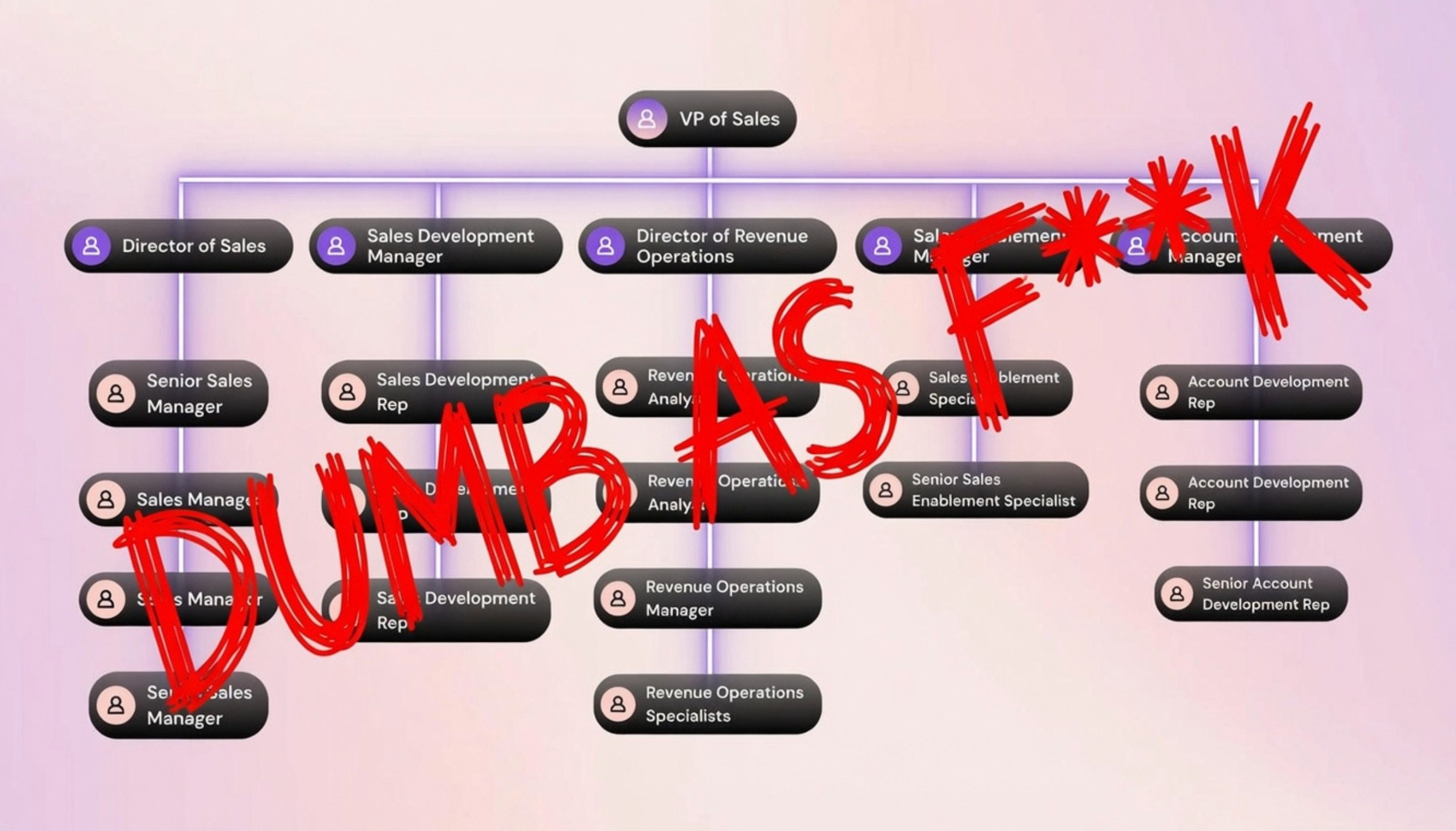
How is a typical sales team structured?
I took a look at our clients and they are structured this way:
Sales Team Structure
| Category | Average | High | Low |
|---|---|---|---|
| Salespeople | 46 | 300 | 1 |
| Selling Roles | 2.45 | 5 | 1 |
| Sales Managers | 5.3 | 30 | 0 |
| Sales Leaders | 1.2 | 4 | 0 |
Selling Role Orientation
| Selling Role Orientation | |
|---|---|
| Territory/Geography | 55% |
| Marketplace/Vertical | 15% |
| Account Size (Enterprise, Large, Mid-Market, SMB) | 15% |
| Product (Specialty sales teams) | 15% |
What does this tell us?
While there are many ways to structure a sales team, things are trending back toward fewer selling roles. More companies are discovering that specialized BDR teams are expensive and ineffective crutches for salespeople who either don’t want to hunt, don’t know how to hunt, or don’t remember how to hunt.
The Expensive BDR Crutch
For years, companies bought into the idea that separating prospecting from closing would free up account executives to focus on “real selling.” On paper it sounded efficient. In reality? It’s often a disaster.
Young, inexperienced reps get thrown into the hardest part of selling where they are expected to book meetings with decision makers while seasoned AEs wait for warmed-up leads that frequently aren’t worth much. Only the strongest salespeople consistently reach actual decision makers. New BDRs? They’re lucky to get time with someone three levels below the decision maker.
As I wrote years ago, we should seriously consider blowing up the BDR role. The cost and inefficiency of teams whose BDRs are struggling to book 1.5 meetings per week no longer makes sense when there are better ways for AEs to fill their own pipelines. Too many companies have turned prospecting into someone else’s problem instead of hiring and/or developing hunters who own the full sales cycle.
When salespeople don’t schedule enough new meetings, we can’t just blame the BDR setup. Call reluctance, need for approval, difficulty recovering from rejection, and perfectionism all play parts in this. The real fix begins with hiring and developing people who are strong in the Hunter competency.
Back to Basics: Hunters and Account Managers
It’s not a common position to take, and I’ll get a lot of hate for this, but in my experience, most companies would be far better off with two primary selling roles: Hunters and Account Managers.
You can give Hunters whatever fancy titles you want and can specialize by company size if need be, but they would be responsible for the entire sales cycle because Hunters find and close new business. They prospect consistently, build pipelines, and drive growth.
Account Managers maintain and grow existing relationships — solving problems, building partnerships, and protecting accounts from competitors. They’re crucial, but they aren’t the same as producers.
This isn’t new thinking. I’ve been highlighting the difference for years: Salespeople push the truck uphill. Account managers keep the trucks running. Major account managers are also expected to hunt for new opportunities within those accounts.
I’ve written before about the squirrels in my yard and they are a perfect analogy. Ernest works nonstop gathering and burying nuts. MT and Lay-Z chase their tails and goof off. Guess who survives the winter? The same dynamic plays out in sales teams: Top performers (like Ernest) carry the load while too many others coast and/or underperform. Don’t let your version of MT and Lay-Z devalue the potential of your sales team.
For account management success, focus on the fundamentals: Build relationships everywhere, regularly check the pulse of the account, seek growth opportunities, and build real partnerships based on trust, respect, expertise, advice, creativity, credibility, history, authenticity, caring, and communication.
Channel Sales – Let’s Call It What It Is
If you sell through a channel, you need channel reps — but please, stop calling them “managers.” They don’t manage crap. They’re salespeople whose job is to get your channel partners to sell more of your stuff.
Title inflation creates the wrong expectations. Channel reps aren’t managing people or operations; they’re persuading partners to prioritize your products. The approach is the same as direct selling: You’re still trying to persuade someone to do something (sell what you sell instead of buy what you sell). If you need them to sign up new partners, that’s a traditional selling role. Here is one more example of channel reps doing traditional selling. If you have unmotivated distributors, your channel reps need to sell directly to end users and then pull your product through the distributors. While it is traditional selling, it’s dumb. Replace the distributor!
Speaking of crappy channel partners, common problems include not communicating opportunities, not sharing what’s in the pipeline, reps who only “mention” your product instead of actively selling it, and ambivalence from their management. Don’t allow yourself to be held hostage by distributors who control territory and lock up your brand without committing to agreed upon revenue/customer goals.
Get clear on expectations, raise standards, and treat channel development like the sales role it actually is.
The Biggest Problem: Management and Infrastructure Failures
Even strong salespeople fail without the right support.
When effective sales systems and processes exist, ineffective sales managers become the primary bottleneck. Most sales managers don’t coach enough, don’t coach the right way, avoid accountability, and can’t debrief calls to identify exactly where things went wrong. They tell reps to “close more” or “make more calls” without teaching tactics, as a youth baseball coach might yell “throw strikes” without fixing mechanics.
Data from Objective Management Group shows that only 18 percent of sales managers should be in sales management and six out of seven sales managers in place today are underperforming.
But here’s the nuance: If systems and processes are nonexistent or complete garbage, even decent managers are set up to fail. Strong sales cultures expect full pipelines, accountability to KPIs, proper training, consistent coaching, CRM discipline, and urgency. Without that infrastructure, structure changes alone won’t move the needle.
What Should Leaders Do Instead?
- Simplify roles around Hunters and Account Managers.
- Eliminate or dramatically reduce ineffective BDR layers.
- Set crystal-clear expectations for channel reps.
- Improve sales management. Train and coach sales managers to role-play, debrief, and confront issues. If they aren’t trainable and coachable, replace them.
- Build (or rebuild) the infrastructure: process, accountability, daily huddles, pipeline reviews, and a hunting culture.
- Use predictive assessments to get the right people in the right seats. Request a sample.
Companies that make these shifts see dramatic results. The difference between mediocre and elite performance comes down to commitment, discipline, and the willingness to stop accepting excuses.
What does your sales team structure look like right now? Are you trending toward simplicity (fewer roles)? Or are you leaning more toward complexity (comp plans that require decoding to figure out how salespeople are paid)?
If you need help with any element of the sales organization, we’re always happy to help. You can reach us here.
Image by Grok AI