
- September 1, 2026
- Posted by: Dave Kurlan
- Categories: Analogies, Sales Process, Understanding the Sales Force
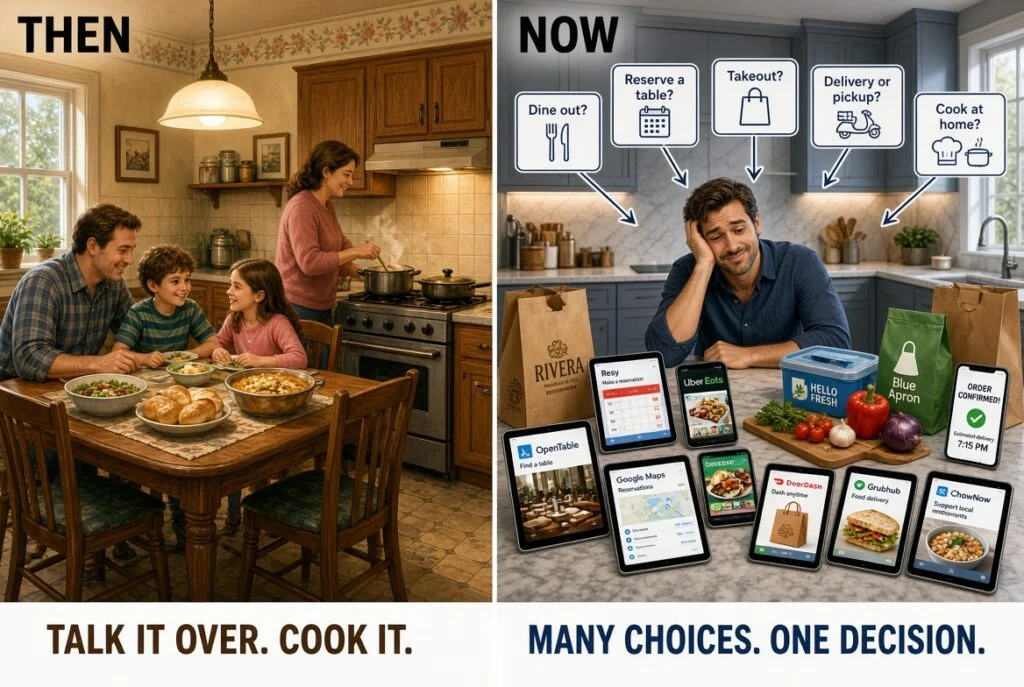
Dinner time used to be easy.
There would be a discussion about what we want to eat for dinner and then someone would cook it.
Today, there are so many options and variables:
- Dine out / choose a restaurant / Reserve a table with Google, Resy or OpenTable
- Take out / choose a restaurant, order online from the restaurant or with UberEats, GrubHub, DoorDash or ChowNow and have it delivered or drive to pick it up
- Dine in / order groceries / Instacart, Delivery or pickup / Prepare your dinner
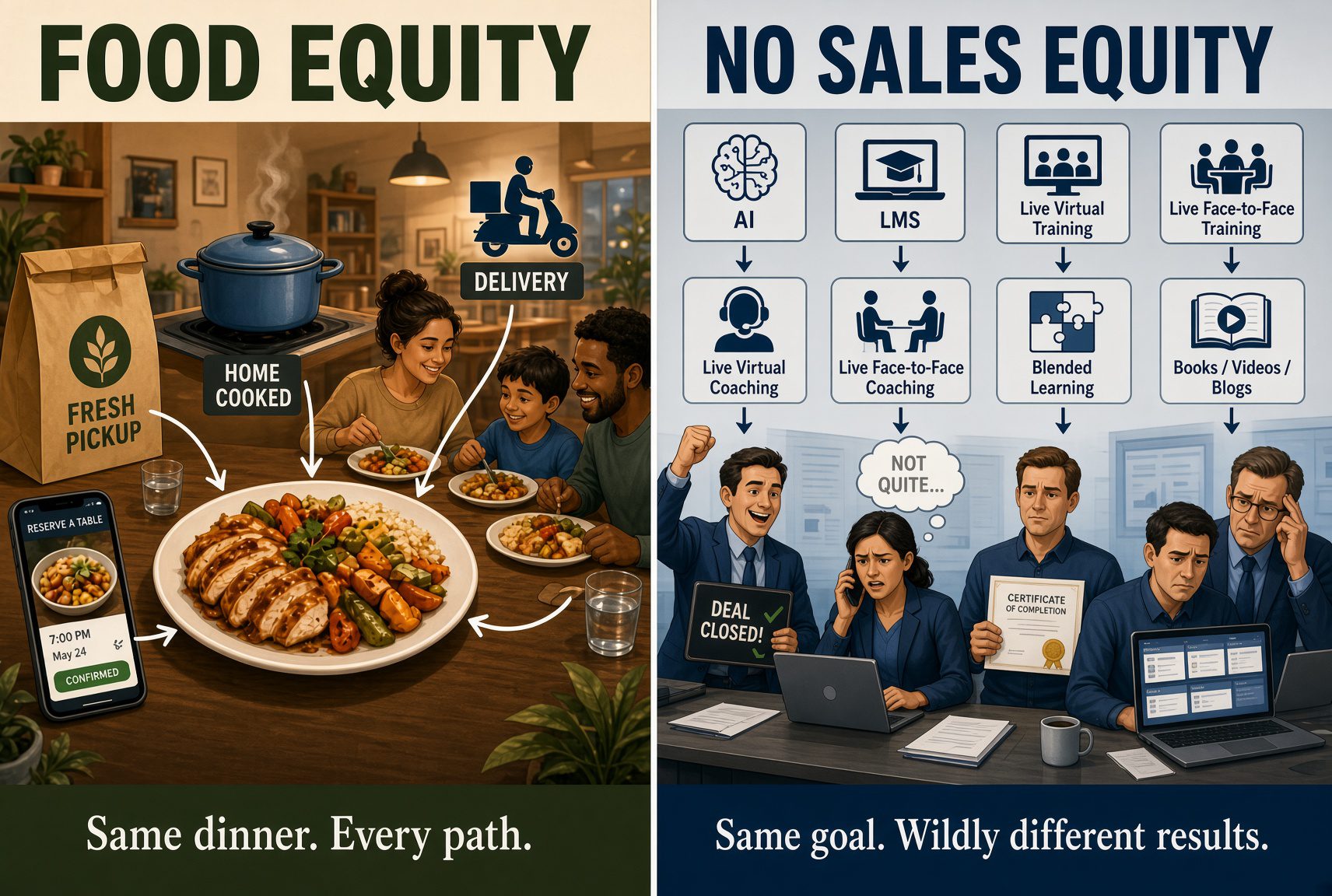
Dinner has Food Equity. You get the same meal whether you cook it, pick it up, or have it delivered.
Helping a sales team get better looks like it should work the same way but it doesn’t.
There is no Sales Equity. Your salespeople do not get the same outcomes regardless of how you choose to develop them.
Let’s take a look at all 8 methods, along with the Pros and Cons of each:
| Method | Description | Pros | Cons |
|---|---|---|---|
| AI | Standalone tools, features inside an LMS, and add-ons sitting next to live training or coaching. Chat, call analysis, role-play bots, tactic lookup. | Fast and always on. A strong post-call debrief can show what a manager will never have time to hear. | Makes salespeople faster more often than it makes them better. Live on-screen prompts sound like a robot. Role-play bots are too easy. You get the tactic, not the coaching. |
| LMS | On-demand modules, videos, quizzes, and completion tracking. Any time zone. Move at your own pace. | Cheap to scale. Useful as pre-work or follow-up for live training and coaching. No calendar fight. | It teaches. It does not train or coach. People start strong and disappear. Completion is not capability. |
| Live Virtual Training | Instructor-led on Zoom or Teams. Usually 60–120 minutes, more often than a workshop. | Short enough to absorb. You can practice, get feedback, and apply it before the next session — if someone designs it that way. | Easy to hide. Camera off, Slack on. Most virtual training is still a firehose, just a shorter one, unless someone inspects whether they used it. |
| Live Face-to-Face Training | Conference room or hotel. Six to eight hours a day, one to three days, plus a quarterly or annual booster if you’re lucky. | Best energy in the room. Best group discussion. Harder to hide than on Zoom. | Firehose. Great day, thin retention. Without reinforcement and inspection, it should surprise no one that the needle barely moves. |
| Live Virtual Coaching | One-on-one or small group over video. The work is the last call, the next call, and the skill in between. | No travel. Easier to do frequently. You can work a real call, not a theory. | Easier to cancel than a plane ticket. Home-office distractions are real. Group Zoom coaching still has lurkers. The format does not fix a weak coach. |
| Live Face-to-Face Coaching | One-on-one or small group in the same room. Call reviews, role-play, pipeline. | Strongest for relationships, candor, and role-play that actually stings. Harder to fake. | Expensive. Travel. Fewer reps. Doesn’t scale. Most companies buy too little of it to change behavior. |
| Blended Learning | A designed mix of content, training, and coaching with one process and one owner. Not “a little of everything we bought.” | Uses each format for what it’s good at: knowledge in the LMS, skills in the room, change in the coaching. | Without a design and an owner, blended is a pile of tools. Salespeople don’t know which path they’re on. Completion gets mistaken for improvement. |
| Books, Videos, Blogs | Articles, videos, podcasts, and books. Including this one. | Cheap or free. Easy to find. Good for awareness and a single idea. | Knowledge. Not training, not coaching, not development. Reading about running the bases is not the same as running them. |
The method is not the magic.
Two salespeople can sit through the same workshop, click through the same LMS, or get the same AI login and finish in completely different places. One starts running the bases. One collects certificates. The gap is not the format. It’s whether anyone identified the real weaknesses, inspected whether the skill showed up on the next call, and coached the person who is still hiding.
We see every method in that table inside client companies. The ones that move revenue have inspection and a human who will not let them skip the hard part. The ones that don’t are usually the shiny ones.
AI is very shiny. Leaders are experimenting with it and trying to justify it. My observation? Their salespeople are turning into smarter idiots.
“Look what I made with AI!”
Version 1: You tell AI to build a 10-slide deck about your company. You outsourced the thinking.
Version 2: You wrote the proposal, used AI to tighten it, and had it build a visual that a decision maker might actually look at — fees, ROI, cost of ownership, differentiators, benefits, timeline, terms. You did the work. The tool made it land.
Version 1 is how you get a smarter idiot. Version 2 is how a salesperson uses a tool.
We watched this movie when inbound was peaking. Leads poured in faster than salespeople could call them, and they got lazy. They stopped asking for referrals and introductions, killed cold calling, and then complained that only one in ten leads was any good.
AI is creating the same condition. Salespeople are handing the hard work to the tool and then wondering why the pipeline sucks.
What actually works is not a new app.
It’s blended learning with an owner: evaluate the team, fix the process, coach the coaches, train the salespeople, then inspect the calls. Each piece in that table gets used for what it’s good at. None of it gets used as a substitute for the work.
The AI that belongs in this mix is the debrief after the call — the one that shows what happened — not the AI that tries to sell for them.
This combination is what consistently helps teams increase revenue:
The steps
1. Get a baseline.
Evaluate the sales team before you buy a method. You need to know who can sell, who looks like they can sell, and which weaknesses will sabotage the training if you ignore them. That tells you what to train and what to coach. Skip this and you are seasoning a meal you haven’t tasted.
2. Fix the process if it’s broken.
If the team doesn’t have a real sales process — or they have one nobody uses — clean it up before you roll it out. Training people on a sloppy process just helps them fail more consistently.
3. Coach the coaches first.
Salespeople don’t change if their managers can’t coach. A small leadership team can do that with self-directed work plus one-on-one coaching. A larger team usually needs a live two-day leadership session and then the same one-on-one coaching. If you train the salespeople first and leave the managers behind, the old habits win the minute the workshop ends.
4. Then develop the salespeople.
When it is practical, start with a live face-to-face kickoff so they meet each other and the process in the same room. Follow it with 12 to 18 live virtual sessions, about an hour each — short enough to absorb, far enough apart to use. The managers, now actually able to coach, work one-on-one between sessions. Put the knowledge piece in an online course built around role-plays that show what a good conversation sounds like in each scenario. That’s LMS used as support, not as the strategy.
5. Inspect the calls.
Record the conversations, upload them, and use AI-assisted debriefs so managers coach the real issues instead of the ones they happen to remember. This is the version of AI that belongs here. It does not sell for them. It shows what happened after they sold — or failed to.
That’s the blend: evaluation, process, leadership coaching, salesperson development, and inspection. Five rows from the table, one owner, no shiny-object detours.
Flexibility still matters. When you cook dinner you add salt, hold the cheese, skip the potatoes, throw in vegetables. When you develop a sales team you do the same thing. Managers may need more coaching. Salespeople may need more time on listening and questions. You might skip prospecting. You might add trade-show selling. The recipe changes. The requirement does not: someone has to own the blend and inspect whether it is working.
Do nothing and your salespeople lose ground to the companies doing something.
Pick the shiny method and you don’t just waste a subscription. You teach the team that thinking is optional.
The trainer matters for one reason that belongs in this article. Methods don’t get a team engaged. A person does. If that person can’t get them bought in and working, you can buy every row in the table and still get nowhere.
If you want help building the blend — and inspecting it — reach out to us here.