
- September 10, 2026
- Posted by: Dave Kurlan
- Categories: Analogies, Sales Assessments Compared, Sales Data and Science, Understanding the Sales Force
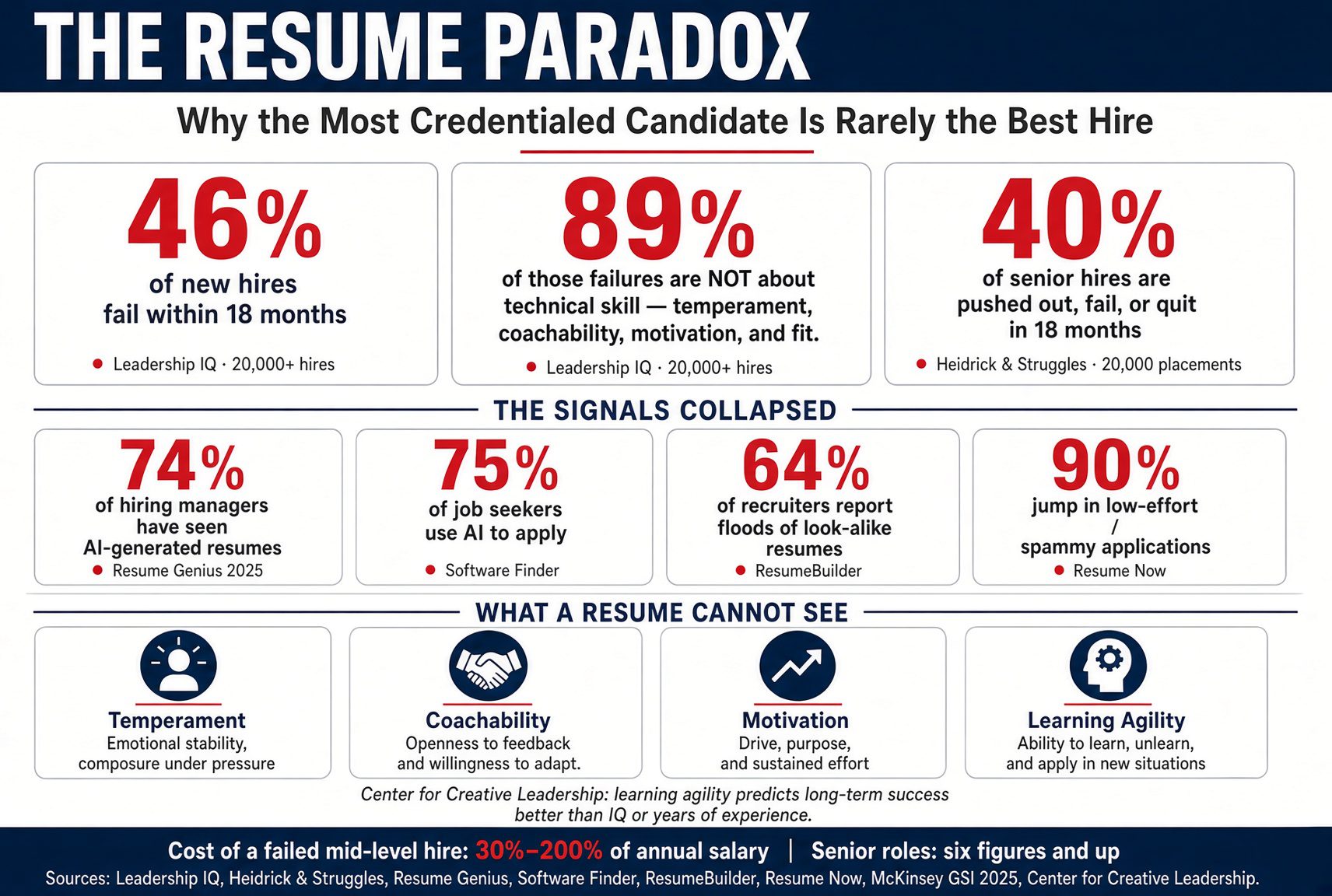
I am saving an embarrassing amount of time and money by using Grok (xAI) the way I used to use interns and consultants, except this one doesn’t need a parking space. As I write this, Decky, one of my GrokBot agents, is updating all of the Baseline Selling slide decks to my spec. Another agent, Webby, is watching the site that hosts this blog and fixing broken links, rendering issues, and plugin updates before anyone notices that something is broken. Grok built the infographic at the top of this article from the statistics below.
That did not happen on day one. I wasted a boatload of time learning what Grok does well, what it does poorly, what I still have to do myself, and which of those distinctions actually save time and money. The short version: AI is a monster on repetitive work and a liability when you ask it to judge people.
Sales recruiting is still asking it to judge people. Worse, most companies are still asking a resume to do it.
You already know how this movie ends. You recruit, you interview, you hire, and then you watch another salesperson miss the number, turn over, or both. And then you start over again. I have been calling that a 50% hit-or-miss rate, with an emphasis on miss, for twenty years. That is not a recruiting engine. It’s an endless loop.
Neil Pretty recently sent me his article, The Resume Paradox: Why the Most Credentialed Candidate Is Rarely the Best Hire. The third-party numbers in it are the reason I wrote this.
What the stats actually say
46% of new hires fail within 18 months. That is Leadership IQ’s study of more than 20,000 hires, and it sits right next to the 50% I have been talking about since flip phones. A number that high means sales leaders are always recruiting, always backfilling, and always starting over.
89% of those failures are not about technical skill. Leadership IQ broke it down: coachability 26%, emotional intelligence 23%, motivation 17%, temperament 15%, and technical competence only 11%. They called the 89% “attitude.” In most jobs that is close enough.
In sales, it is only partially right.
Technical skill is product knowledge and industry experience. That is the 11%. That is also the part a resume can fake, especially now. The other 89% includes the selling competencies that you can’t measure on a resume: Will to Sell, Sales DNA, and the Tactical Competencies that decide whether someone – not can, but will – actually execute the sales process and succeed. Someone’s Need to be Liked is not a vibe. It is a hidden weakness that stops a salesperson from asking the next question. Discomfort talking about money does not have a workaround. It is a skill gap that kills the deal on the way to qualification. A salesperson who needs to think it over when they buy will let every prospect think it over when they sell. Leadership IQ filed that under attitude because they were not measuring sales. We are.
That is the point of a predictive, sales-specific assessment. Used as a filter, in the second step, right after the online application, OMG’s Sales Candidate Assessment identifies the people who are not likely to succeed in this role, in this selling environment, before anyone wastes a morning on their resume, a phone screen, three interviews, or a signing bonus. You stop reading fiction and start talking to the candidates who will successfully do the work.
OMG measures three buckets the resume cannot see. Will to Sell: Desire, Commitment, Motivation, Outlook, and Responsibility. Sales DNA: the six hidden weaknesses that sabotage otherwise decent selling skills (Stays in the Moment /Controls Emotions, Not Needing to be Liked, Non-Supportive Beliefs, Non-Supportive Buy Cycle, Discomfort Discussing Money, and Rejection). Tactical Selling Competencies: the ten recognizable selling skills (Hunting, Reaching Decision Makers, Building Relationships, Consultative Seller, Value Seller, Qualifier, Presentation Skills, Closing, Sales Process and Sales Technology) that, in this validation study, most clearly separate the people who produce from the people you end up replacing. Recommended candidates who get hired land in the top half of the team 72% of the time. Not-recommended candidates who get hired anyway do not land there at all. First-year turnover is 9% versus 33%.
40% of senior hires are pushed out, fail, or quit within 18 months. Heidrick & Struggles tracked 20,000 of its own placements. That is not a growth path. That is a death wish. Companies live on backfill. I have watched too many sales-leadership trainings get postponed because “we need to wait until we fill the open leadership roles.” There is always an open leadership role. If you wait for the roster to be complete, you will never take batting practice.
The resume got worse while you were still trusting it
AI did not invent bad hiring. It just poured gasoline on the document you were using as a crystal ball.
- 74% of hiring managers have already seen AI-generated resumes
- 75% of job seekers use AI to apply
- 64% of recruiters are staring at floods of look-alike resumes
- There has been a 90% jump in low-effort, spammy applications
You are not choosing among candidates. You are choosing among mostly crappy works of fiction. The most polished one is usually the person who is best at looking for work, not the best at selling.
It is more expensive than the spreadsheet says
Most analyses put a failed mid-level hire at 30% to 200% of annual salary once you add lost productivity, rehiring, and the mess they leave behind. Senior roles start at six figures and climb. For some companies that is an ugly line item. For others it is why they stop trying. And a shocking number have waved the white flag. The cost of getting it wrong is now baked into the process.
Those percentages still understate sales.
A bad salesperson does not just fail quietly in a cubicle. They don’t create the opportunities they should have created, don’t close the good ones they do find, lose accounts they should have kept, and after you finally terminate them, leave a territory empty long enough for a competitor to take a free shot on goal. Add that up and a sales hiring mistake easily runs $250,000 and up — per hire. Not because that was the salary. Because that’s what didn’t flow through the pipeline.
You do not need another year of that experiment.
Where AI belongs — and where it does not
AI makes the top of the recruiting funnel noisier. Used on the right steps, it makes the middle of the funnel faster. Teach an AI agent the repetitive parts of recruiting: posting, screening logistics, scheduling, follow-up, and status updates to the ATS. Then put an accurate, predictive sales candidate assessment in as the second step so the humans on your team talk only to sales candidates who will succeed in the role you are actually hiring for.
That is the engine. Not a better-looking resume. Not a longer interview. Not a hiring manager who “just has a feel.”
We can help you build it — the sequence, the role specs, the assessment, the interviews that come after the filter, not before it. If you want an extra set of eyes on the process you have been repeating, just ask.