
- July 30, 2026
- Posted by: Dave Kurlan
- Categories: Baseball and Sales, Understanding the Sales Force
As is often the case, I’m going to lead with a baseball analogy before we get to the guts of this article.
In 2024 and 2025, the Boston Red Sox had their right fielder, Wilyer Abreu, in the lineup only when the opposing team started a right-handed pitcher. Abreu bats left-handed and, like a lot of lefty hitters, he wasn’t effective against left-handed pitching. The team told him to work on it. Over the off-season of 2025-26 he did. In 2026 he’s in the starting lineup every day, hitting both lefties and righties, and he’s among the best in baseball at handling left-handed pitching.
Teams ask hitters to fix all kinds of things — stop chasing pitches out of the zone, catch up to high velocity, lay off the breaking stuff. In my strange little mind, the ask that matches up best to sales is when a hitter is told he has to get better at one specific pitch: the curve ball.
The Reaches Decision Makers competency is just 1 of the 21 Sales Core Competencies, but it’s the curve ball of competencies.
Hitting the Curve Ball in Sales
The Reaches Decision Makers competency is just 1 of the 21 Sales Core Competencies but it’s the curve ball of competencies.
See all 21 Sales Core Competencies and how salespeople score in them here.
The statistics are eye opening. I’m going to share some data from Objective Management Group, which has assessed more than 2.5 million salespeople.
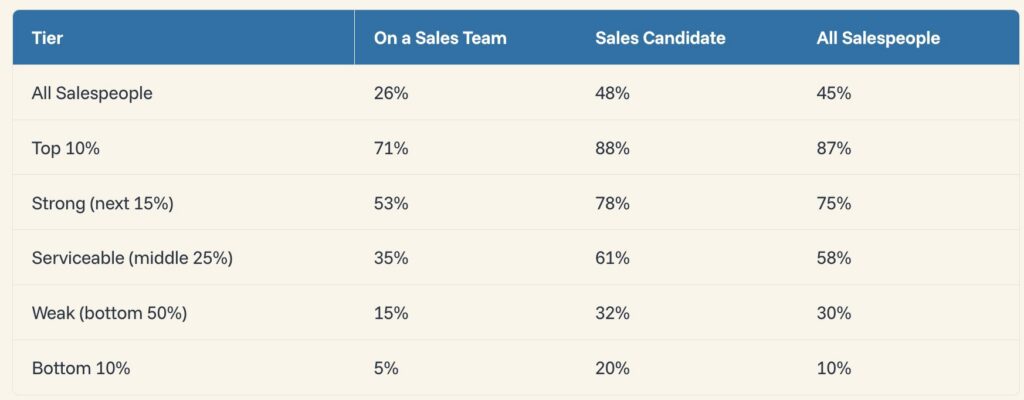
There is so much to dig into in the table above.
First, the sales candidates – those who are applying for sales jobs – are generally stronger than salespeople who are currently on a sales team. If we go back to baseball, these candidates are like free agents, on the open market to see what their true value is. The entry level candidates in that data would skew the percentages down, which means that the veteran salespeople on the market are even stronger. These scores also suggest that many of the salespeople currently on a sales team are not only mediocre, they are also complacent.
Second, the bottom 50% of all salespeople – the weak group – is atrocious when it comes to reaching decision makers.
Third, depending on the group, the top 10% are between 4x and 14x better at reaching decision makers than the bottom 10%.
I’ve previously written that salespeople who do reach decision makers early in the sales process are 341% more likely to close the business, so this competency is the equivalent to the batter who slams 50 home runs in a season. It’s the big hitter and in sales, big hitters reach decision makers.
I saw this must-read article by Stephen Messer.
He is selling a tool, but the reason for the tool got my attention. The middle of his article had this bar graph.
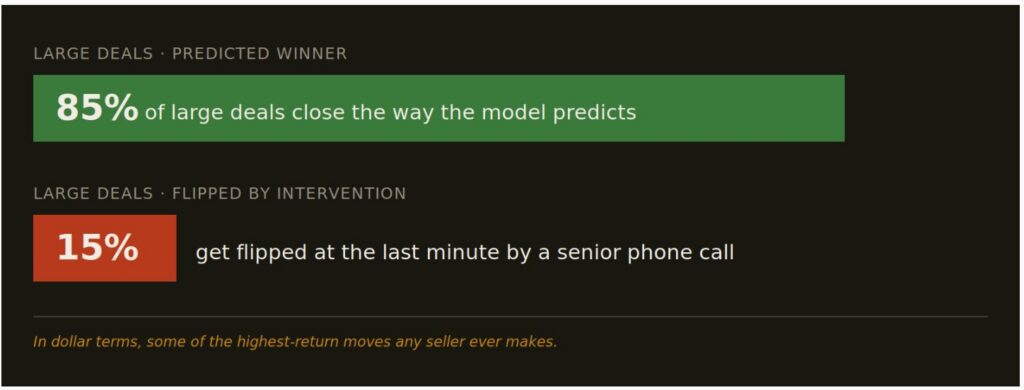
It’s the 15% number.
Large deals that were all but done except for the ink on the paper, were getting awarded to another company at the last minute because someone reached the decision maker. In most cases, it was the CEO from the eventual winning company making a call to the CEO of the buying company. There may have been another CEO making the introduction. While it wasn’t always the CEO on each end of this phone call – yes a phone call – you get the gist. Getting to the CEO wins large deals.
This all begs the question, why do most salespeople find it so difficult to reach decision makers?
Most salespeople don’t have trouble per se as much as they simply don’t try.
But why don’t salespeople try? Here are my 3 top reasons:
- They are following the path of least resistance is easier. They continue working with their primary contact or influencer. It’s familiar, nice, comfortable, low risk, and often leads to dead ends and/or losses.
- They are intimidated by the actual decision maker. They don’t speak the same language, don’t believe they belong at the table, and because of their limited experience in those scenarios, they fail to bring value to the conversation.
- They have too much Need to be Liked. Salespeople worry that if they say the wrong thing, ask a tough question, or attempt to push back on the CEOs thinking, the CEO will dislike them. In fact, the opposite is true. That’s how you differentiate and earn the CEO’s respect. That need to be liked also prevents them from convincing their contact to make the introduction because they are afraid their contact will become upset.
Most salespeople must get a LOT better at this competency. Improvement consists of three elements:
- Strategy – why reaching Decision Makers is important and what will change upon effective implementation
- Tactics – how reaching Decision Makers is actually achieved
- Sales DNA – the thinking and programming that ultimately determines what salespeople will and won’t do. (The need to be liked is in a salesperson’s Sales DNA.)
If we take the same approach and apply it to hitting a curve ball the three elements are the same:
- Strategy – why hitting the curve ball the opposite way is the best approach
- Tactics – how to recognize, wait on, and drive the pitch the opposite way
- Baseball IQ – the thinking and programming (ego in this case) that makes them want to pull that pitch instead
Reaching decision makers isn’t more or less difficult than mastering any of the other 9 Tactical Selling competencies.
But it is more important!
You can improve in the other 9, but if that improvement isn’t taking place with the right person, it’s all for naught.
If a hitter is in a 2-strike count, but can’t hit the curve ball, guess which pitch will be thrown next! The curve ball is the out pitch! And the sales version of the out pitch is the inability to reach decision makers except the salespeople are striking themselves out.
Get some help by reaching out to us here.