
- October 19, 2026
- Posted by: Dave Kurlan
- Categories: Analogies, Baseball and Sales, Sales Pipeline and Forecast, Sales Process, Understanding the Sales Force
It’s late October and in Central Massachusetts we’re in peak foliage season. These are the brightest fall colors I’ve seen in years. Leaves are falling all over our property. I don’t see every one of the millions of them, but I know they’re there.
Most LinkedIn posts about selling appear in my feed or notifications the same way. I don’t see all of them, but I know they’re there. One fantastic post I saw got my full attention. It came from my friend Keenan, who wrote Gap Selling and it led with this terrific graphic.
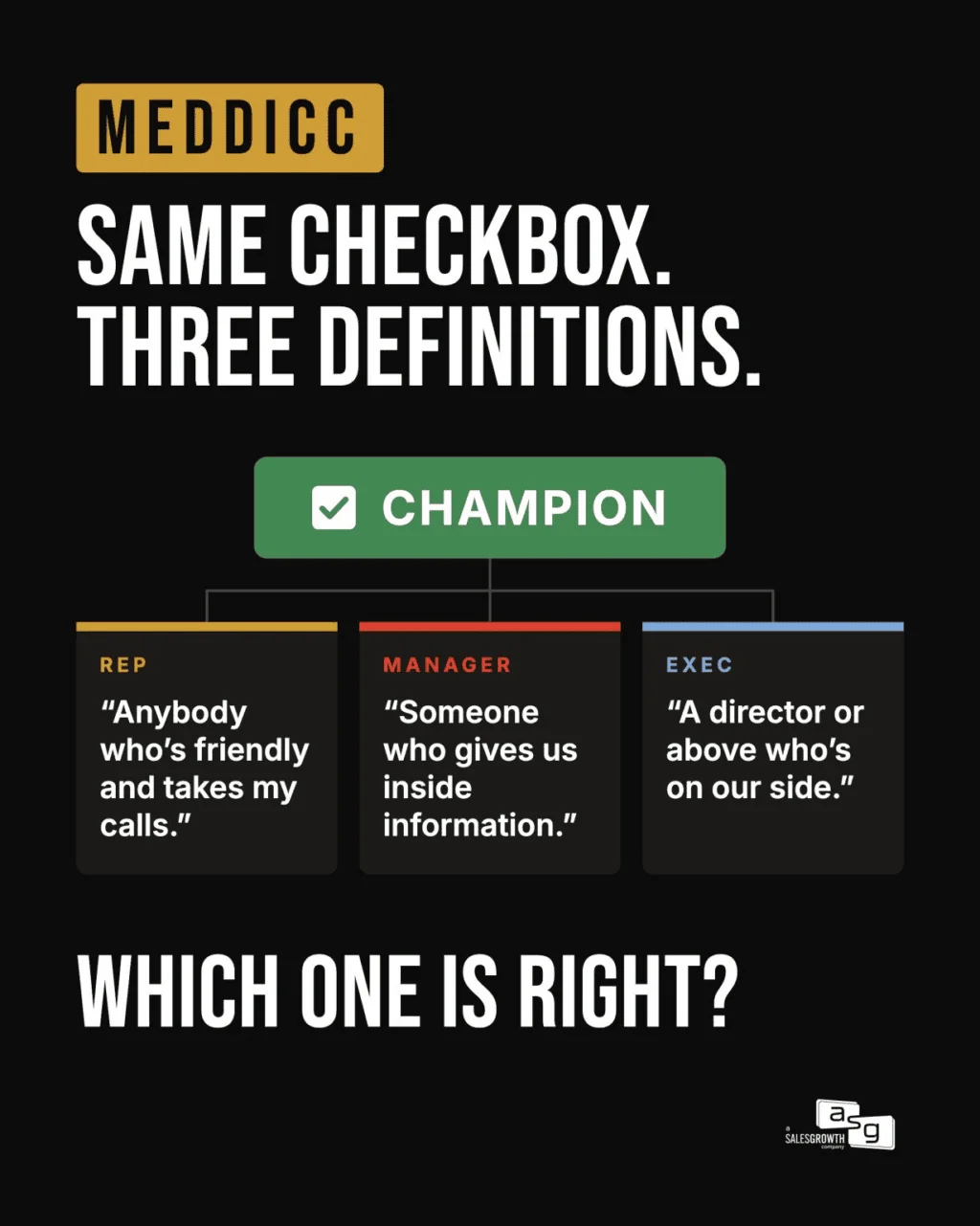
Keenan made a great point. One of the big problems with the MEDDIC sales framework is that depending on who you ask, the rep, the sales manager, or the sales leader, you get three different answers definitions, and criteria for the letter C for Champion. Everyone has a different criteria, everyone has a different answer, and all of it rolls up into faulty pipeline and forecast data.
Same problem for Economic Buyer, Metrics, and Identify Pain.
You can see the issue, right? It’s obvious. And while Keenan explains a workaround, it shouldn’t require one.
Now the fun part! For me it happens when I pile on and criticize MEDDIC even more.
The six letters in the MEDDIC acronym are quite popular as a sales framework, just as these six tools are popular for building a home:
- Tape measure
- Level
- Framing square (or speed square)
- Circular saw
- Drill/driver
- Hammer (or nail gun)
These are not the only tools you would use to build a house and the six letters aren’t the only criteria you need to run a successful sales cycle. The carpentry tools are also standard and useful, just like the MEDDIC letters, but the order matters – a lot. You measure and square before you cut. You cut before you fasten. You check level as you go, not after the walls are up and locked in. Use the hammer and drill first and the structure ends up crooked, weak, or needing to be torn apart and rebuilt. The tools themselves aren’t the problem. Using them without the proper sequence is.
There is no defined sequence for MEDDIC. Some of the information for those checkboxes is much harder to obtain if you aren’t working the process in the proper order.
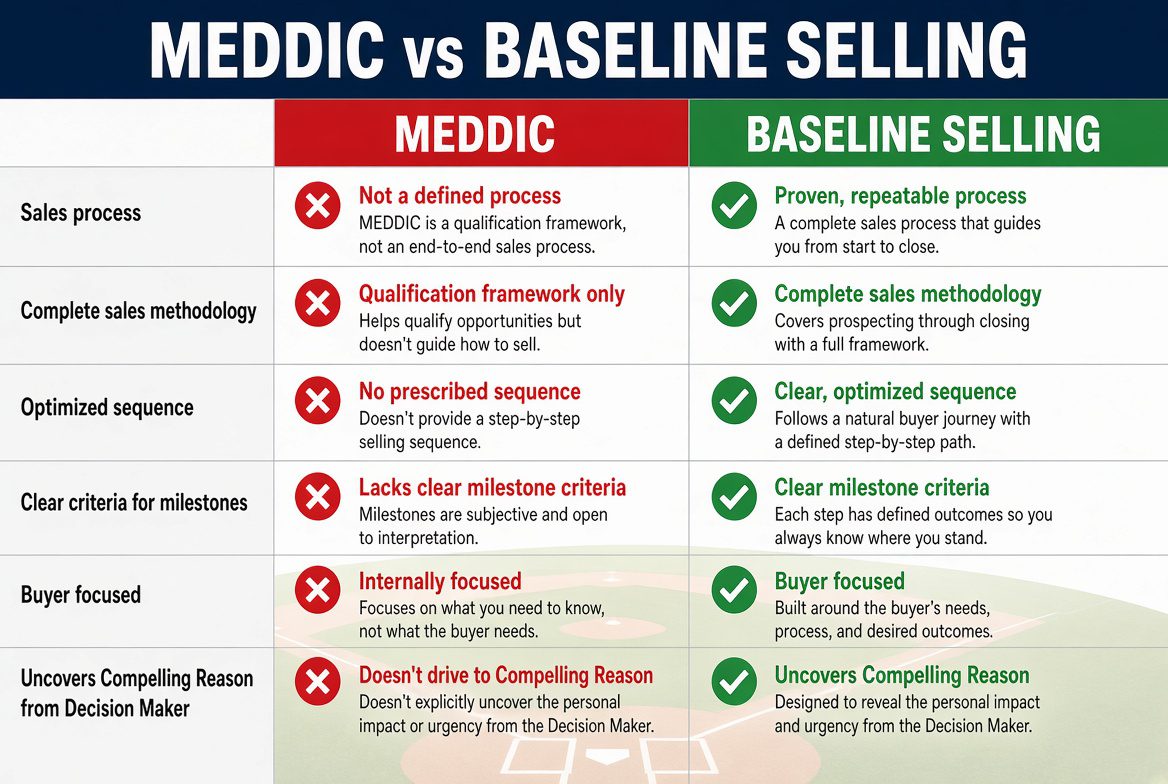
That’s the big difference between MEDDIC and Baseline Selling.
Watch the Baseline Selling walk-through.
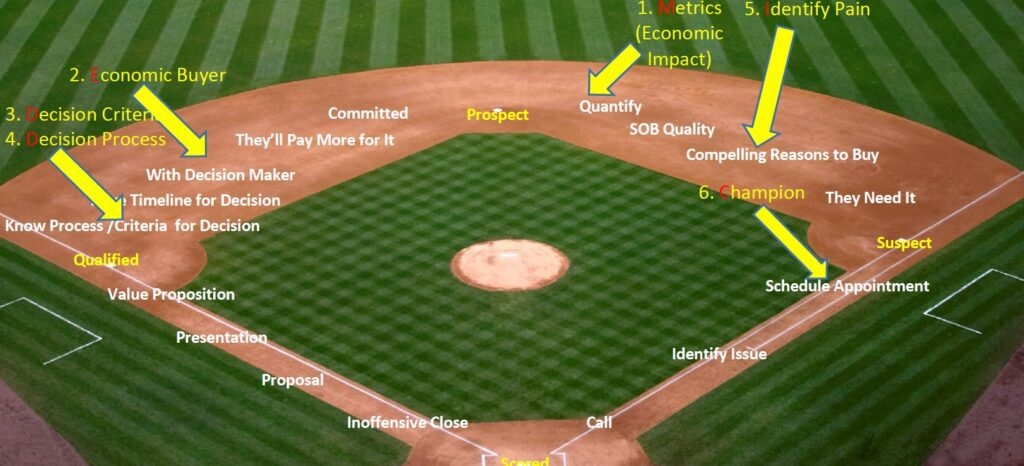
Baseline Selling’s default is four stages but it can be expanded to six. Each stage has several non-negotiable milestones that must be met. You can add to those milestones but you can’t remove them. In the image below you can see the default Baseline Selling milestones laid out on the baseball diamond in four stages, with yellow arrows showing where the comparable MEDDIC criteria take place. Notice how the letters are scattered across the diamond instead of following the counter-clockwise progression of the bases. MEDDIC is mostly about what you learned, not what you accomplished with your buyer.
Solution Selling is another popular sales methodology, and it serves as an excellent example of what happens when you don’t have the optimum sequence in your framework. Solution Selling says to qualify in what is basically the second stage of the process, as you can see in the image below.
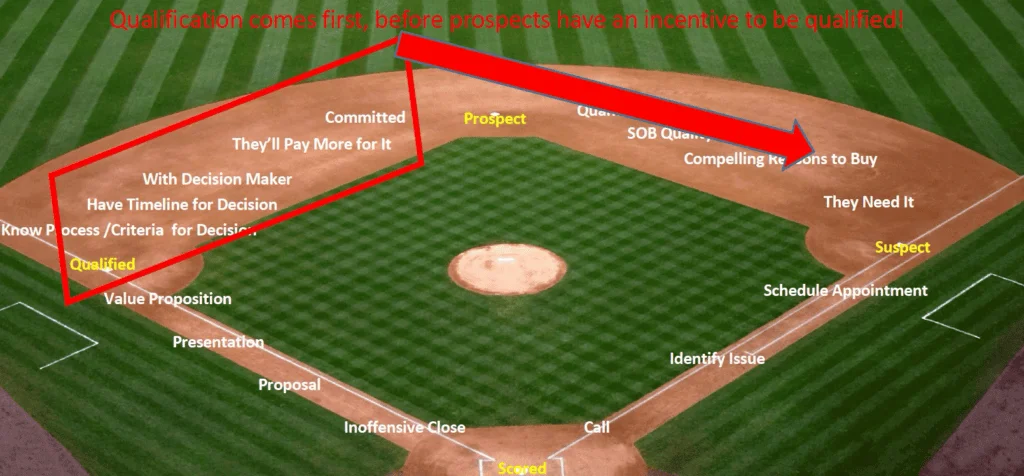
Prospects don’t want to be qualified that early in the sales process. It’s annoying. It’s salesy. It’s intrusive. They know what you’re doing. They don’t want to cooperate. So you disqualify what could be a good opportunity because you couldn’t get them qualified. But if you first develop SOB Quality (trust, relationship, differentiation, respect, and caring about them), uncover their compelling reason to buy from you, and create urgency, they will gladly allow you to qualify them.
Return to the image of MEDDIC mapped onto Baseline Selling and look at the order of the letters. Not only does the sequence fail to work in your favor, it’s also incomplete.
For example, who gives a rodent’s behind that you have a champion if that person has no real influence, no access to the economic buyer, and no vested interest in the outcome? That’s Golden Retriever lazy—letting somebody who doesn’t control the money or the decision do your selling for you. A real champion can still matter when they have influence, access, and skin in the game. The lazy version the graphic shows does not.
You’ll say, “It’s not like that!”
Of course it is. As I learned from a friend in Alabama, “Don’t piss on my boot and tell me it’s raining outside!”
And then there’s Identify Pain. As I wrote in the book, Baseline Selling – How to Become a Sales Superstar by Using What You Already Know About the Game of Baseball®, Elmer Wheeler developed the concept of pain as a buying motive in his 1946 book How to Sell Yourself to Others. He’s also the guy who invented “Don’t sell the steak. Sell the sizzle.”
Today, nearly 80 years later, pain is only one half of the buying motive. Opportunity is also a buying motive, especially if you’re selling to the C Suite. That’s why Baseline Selling’s Compelling Reason to Buy is so much more powerful. It includes both sides of the buying motives, and it differentiates between the reason to buy what you sell and the reason to get it from you. Pain misses those two important factors.
Watch Baseline Selling compared to the other sales processes and methodologies.
If you use and like MEDDIC, keep using it. But use it with your eyes open and beware of its many limitations. There are so many profiles on LinkedIn that list being an expert in MEDDIC in their headline. I can say that about baseball. I’m an expert in batting average, hits, RBIs, home runs, runs, and ERA. I know those stats and what they mean inside and out. But would you want me coaching professional baseball players? Fugetaboutit!
You would want me coaching your professional sales team, though. You need them to have quality two-way conversations that move the sales process forward, and that requires a lot more than knowledge of MEDDIC. Reach out to us. We can supercharge your sales team!